Outdoor Restaurant Tables & Chairs Wholesale: Factory-Direct Sourcing from Vietnam
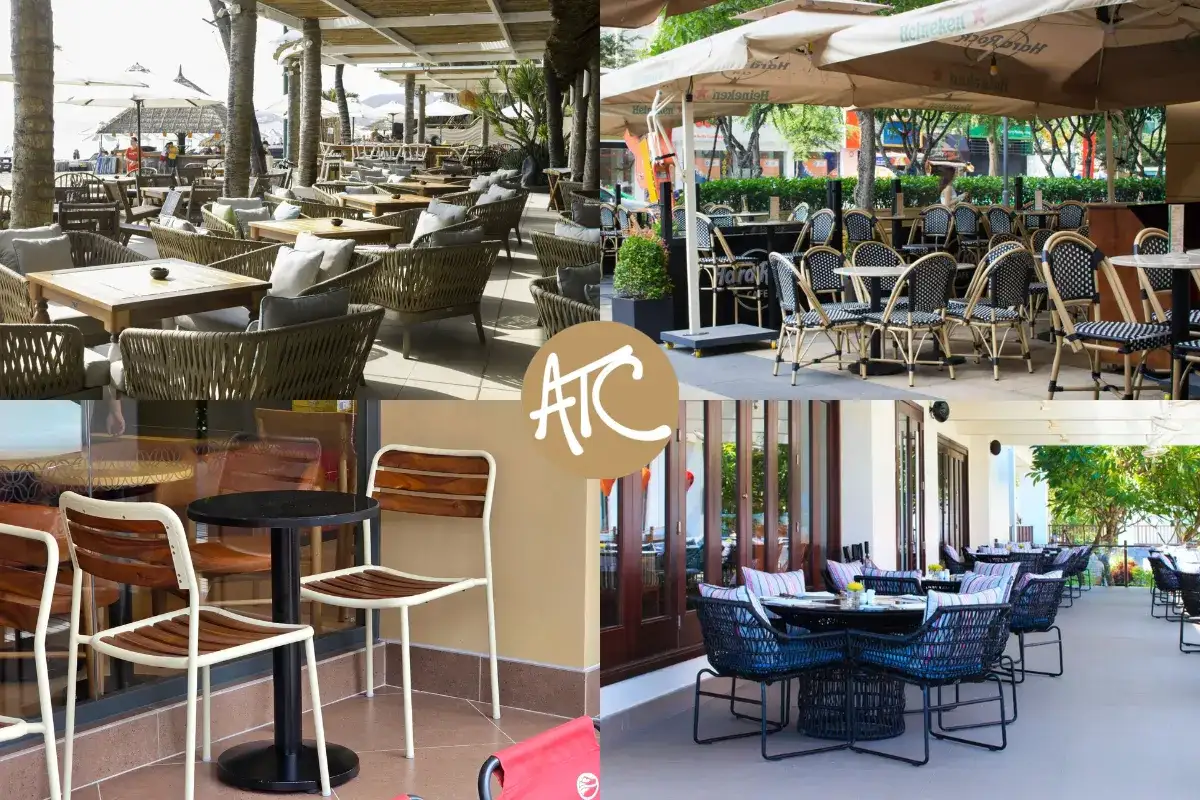
Choosing outdoor restaurant tables and chairs wholesale requires more than comparing attractive designs and unit prices. For restaurants, cafés, resorts, and hospitality projects,
furniture should suit the actual outdoor environment while supporting daily operations, guest comfort, maintenance, and efficient use of space.
Commercial buyers should evaluate materials, frame construction, dimensions, table-chair compatibility, seating capacity, storage, and cleaning requirements. For bulk orders, supplier capability, quality control, packaging, container loading, and lead time are equally important. This guide covers the key factors from product selection to factory-direct sourcing, helping buyers define clear requirements before requesting quotations or placing orders.
1. How to Choose Outdoor Restaurant Tables and Chairs for Commercial Use
Restaurant furniture is used differently from residential patio furniture. Chairs may be moved repeatedly throughout the day, tables may need to accommodate different party sizes, and surfaces require frequent cleaning. Outdoor exposure can add further demands.
Before comparing products or suppliers, buyers should first define where and how the furniture will be used.
1.1 Define the Outdoor Dining Environment
A covered restaurant terrace, beachfront dining area and rooftop patio can expose furniture to very different conditions. Understanding the environment helps determine appropriate materials, construction and maintenance requirements.
Sunlight, rain, humidity and proximity to the sea should all be considered. In coastal locations, for example, salt-laden air can make material selection, hardware and surface finishing particularly important.
Exposure is only one part of the specification. Buyers should also estimate operating hours, frequency of use, cleaning routines and how often employees will move or rearrange the furniture.
A product suitable for an occasionally used covered terrace may not necessarily be the right choice for a busy outdoor restaurant operating throughout the day.
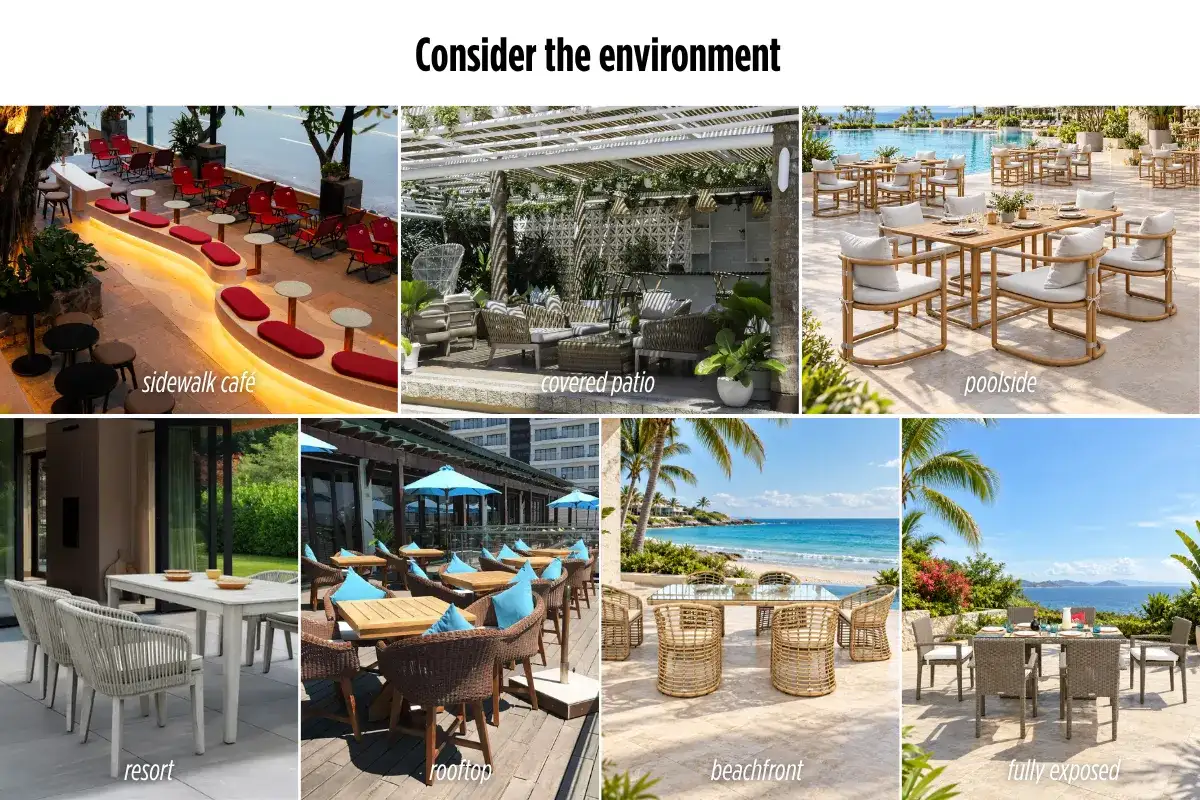
From covered patios to fully exposed beachfront areas, each setting places different demands on outdoor restaurant furniture.
1.2 Choose the Right Types of Tables and Chairs
A commercial dining area rarely needs only one furniture configuration. The appropriate product mix depends on the restaurant concept, available floor area and expected customer groups.
Outdoor dining chairs can include armchairs, armless chairs, stackable models, woven chairs, rope chairs and wooden designs. When sourcing bulk outdoor dining chairs for restaurants, buyers should consider more than appearance. Seat dimensions, chair weight, stability, armrest clearance and storage requirements can all affect daily operations.
The same considerations apply when purchasing commercial restaurant tables wholesale. Two-person, four-person and larger tables in round, square or rectangular formats can support different layouts and party sizes. Buyers can also consider wicker dining sets for outdoor restaurant and hospitality dining areas.
Restaurants with bar, rooftop or casual areas may also require bar tables and stools alongside standard dining furniture.
A coordinated furniture family can help maintain a consistent design language, while combining several table sizes can provide greater flexibility for different party sizes.
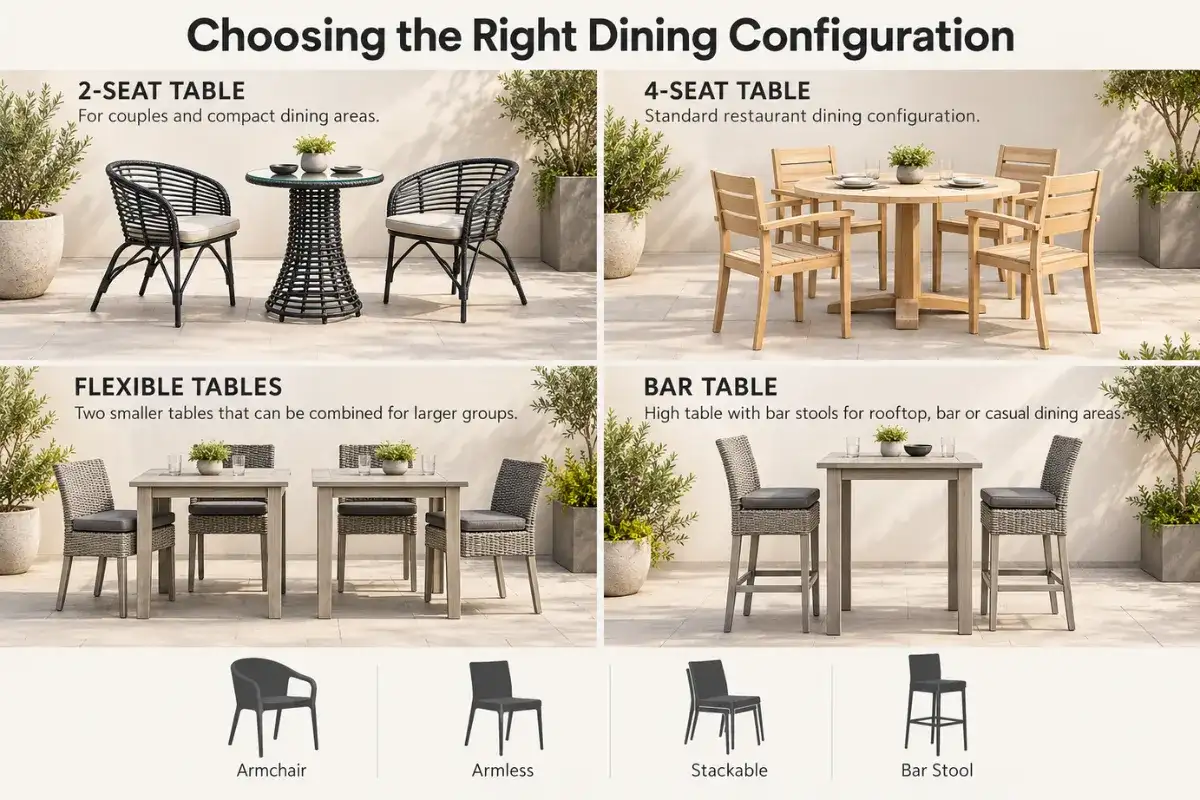
Table size and chair type should be selected together to support seating capacity, storage and practical restaurant operations.
1.3 Plan Seating Capacity and Restaurant Layout
Maximizing the number of chairs does not necessarily optimize restaurant operations.
Before confirming quantities, buyers should place the actual furniture dimensions into the floor plan. Entrances, service routes, circulation paths, columns, planters and other fixed elements need to remain functional after the tables and chairs are positioned.
Table size also affects flexibility. Smaller tables can be combined when larger groups arrive, while larger fixed configurations may suit areas designed for families or group dining.
The objective is to balance: seating capacity + guest comfort + staff circulation + service efficiency + layout flexibility
Testing the layout before placing the order can also reduce the risk of purchasing furniture that technically fits the floor area but creates operational problems once installed.
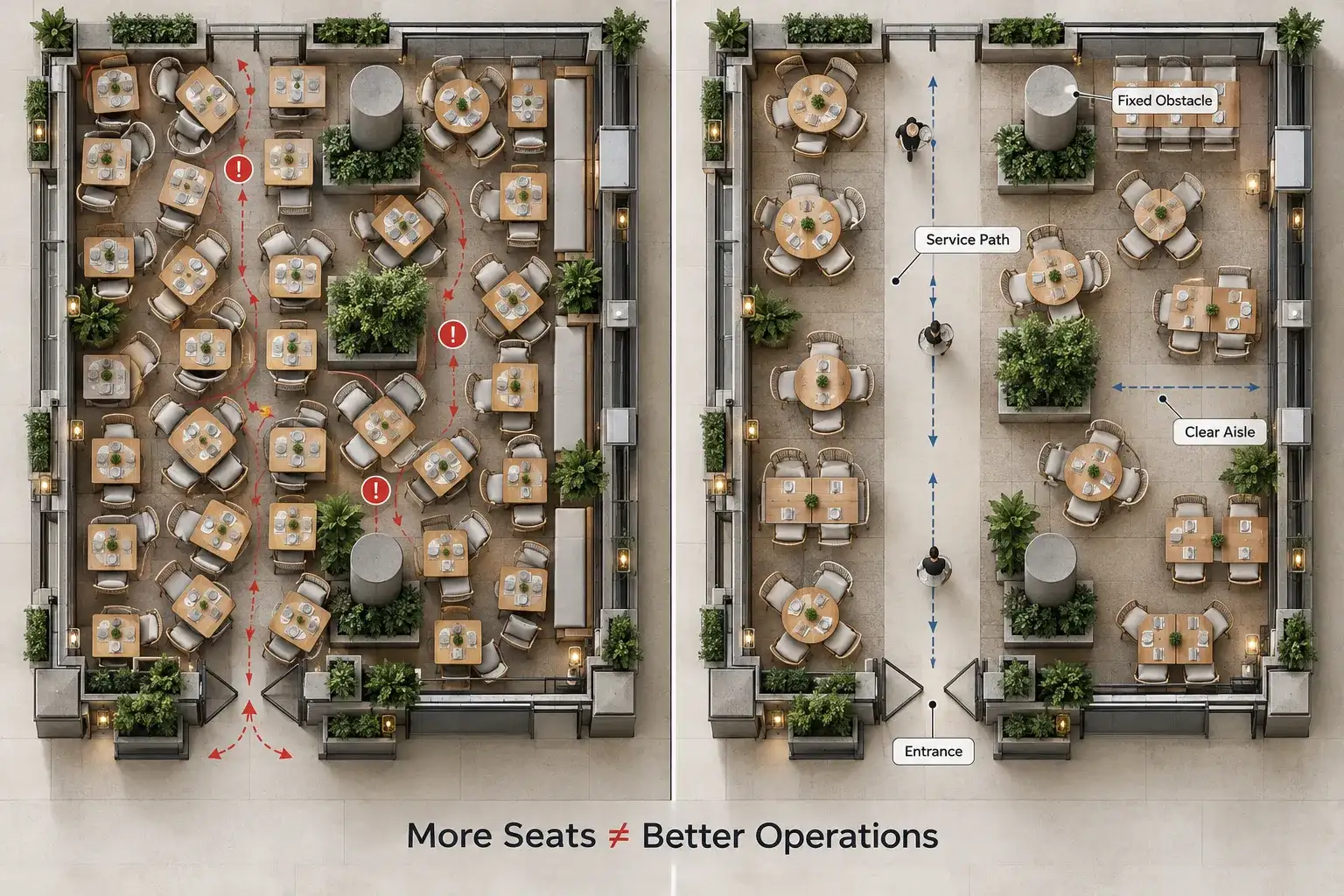
A balanced floor plan considers seating capacity alongside entrances, staff circulation and fixed obstacles.
2. Materials and Specifications for Outdoor Restaurant Furniture
There is no single material that is automatically best for every outdoor restaurant. Material selection should reflect climate, exposure, design requirements, maintenance capacity and expected use.
Commercial buyers should therefore compare the complete construction rather than choosing furniture based only on its visible surface material.
2.1 Compare Commercial Outdoor Furniture Materials
Powder-coated aluminum is widely used for outdoor dining furniture because it can provide a relatively lightweight structural frame and works with different design materials, including synthetic wicker, rope and wood. Buyers should inspect frame construction, welding, finishing quality and the suitability of the coating for the intended environment rather than assuming all aluminum furniture performs identically.
HDPE synthetic wicker provides the woven appearance associated with traditional rattan while being designed for exterior applications. Relevant specifications include strand quality, UV stability, weave consistency, tension, color consistency and attachment details. Buyers should also inspect the frame underneath the weave.
Outdoor rope is frequently used for contemporary hospitality furniture. Its open construction can create a visually lighter design and can be combined with aluminum or wood. Important factors include rope composition, UV performance, weaving tension, attachment points and ease of cleaning.
Teak and other outdoor woods offer a natural appearance suited to restaurants, resorts and hospitality spaces. Wood, however, changes as it is exposed to outdoor conditions. Buyers should understand the specific wood species, finishing system and maintenance requirements rather than treating all outdoor wood as maintenance-free.
Material names alone are therefore not sufficient specifications. Two chairs described as “aluminum and wicker,” for example, can differ significantly in frame construction, wicker quality, dimensions and workmanship.
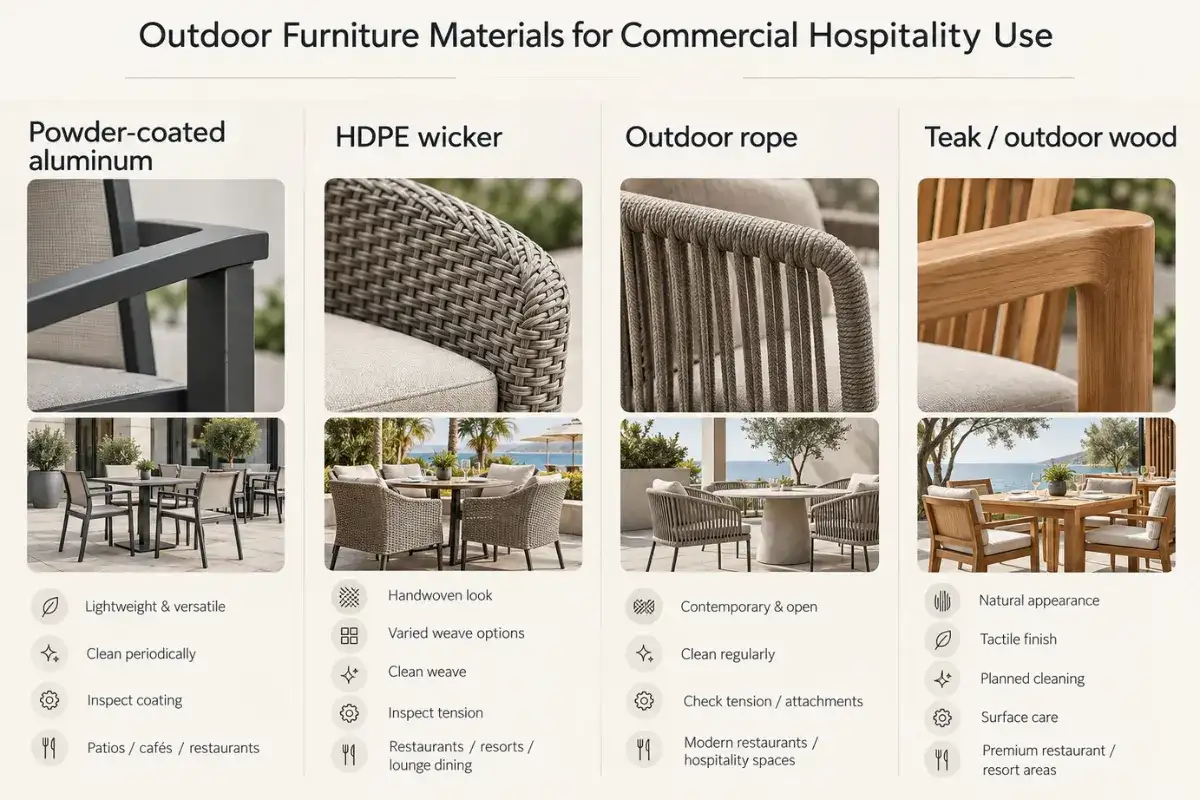
Powder-coated aluminum, HDPE wicker, outdoor rope and teak each offer different characteristics for commercial outdoor dining spaces.
2.2 Check Frame Construction, Dimensions and Stability
The structural frame is one of the most important elements of commercial furniture.
Depending on the design, buyers should review frame material, tube dimensions where relevant, joints, welding, reinforcement and overall stability. A chair should sit steadily on the floor without unnecessary movement, while a table base should adequately support the selected tabletop.
Dimensions should also be evaluated as a system.
For chairs, relevant measurements include overall width and depth, seat height, seat depth, backrest dimensions and armrest height. For tables, buyers should review height, tabletop dimensions, base footprint and available legroom.
Table-chair compatibility is particularly important. An armchair may have appropriate seating dimensions but still be inconvenient if its armrests cannot move sufficiently under the selected table.
Checking actual dimensions before production is more reliable than judging compatibility from product photographs.
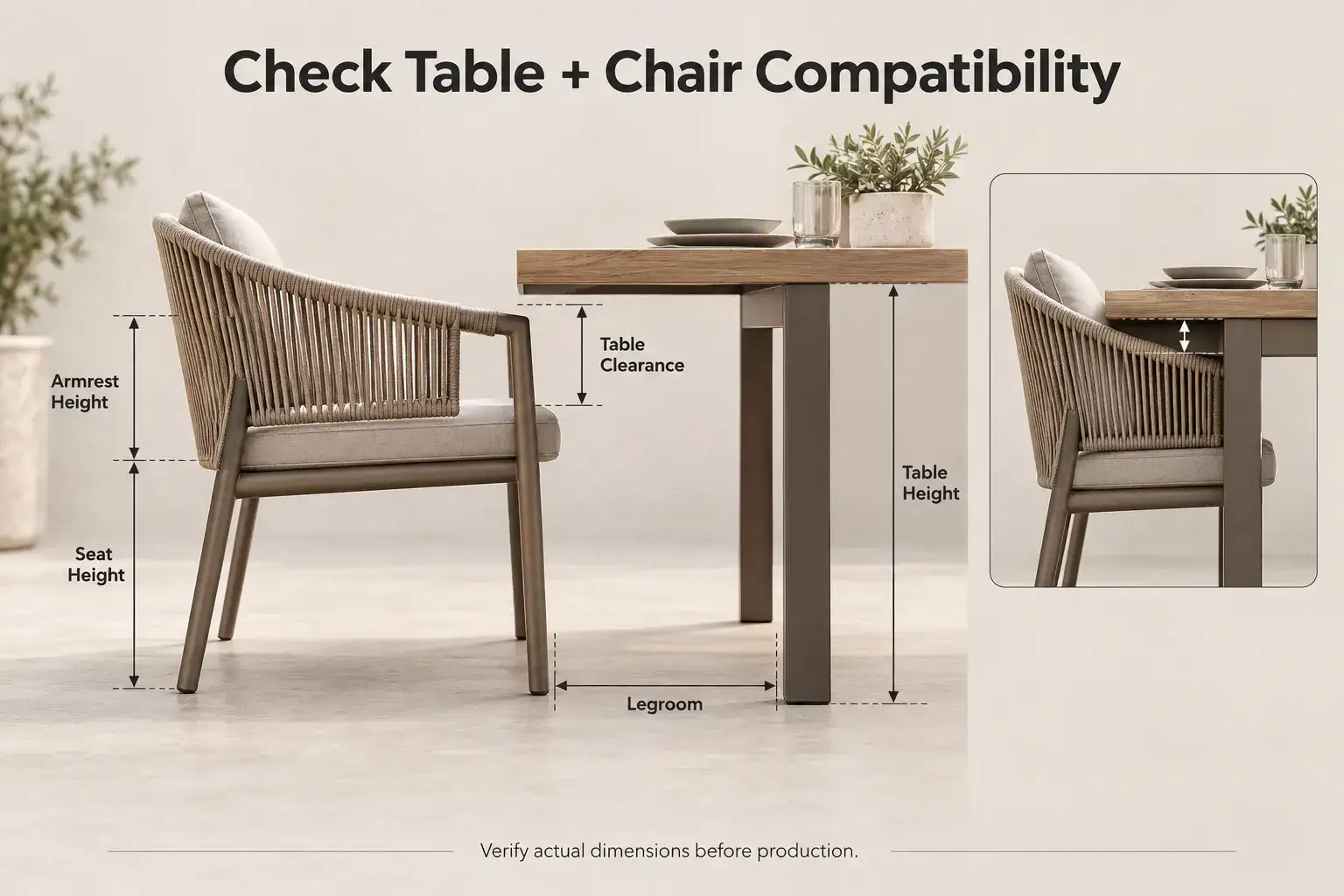
Table height, seat height and armrest clearance should be reviewed together to avoid compatibility issues in commercial dining setups.
2.3 Consider Cushions, Fabrics, Stackability and Maintenance
For cushioned restaurant seating, buyers should clarify fabric type, cushion construction, cover design and cleaning requirements.
Water-repellent fabric and waterproof construction are not interchangeable terms. If cushions will remain outdoors, the complete cushion system - including the cover, filling and drying conditions - needs to be considered.
Removable covers and zippers can make routine care or replacement easier. Restaurants should also establish a storage plan for cushions when severe weather or extended periods of non-use are expected.
Operational considerations are equally important for non-upholstered products. Stackable dining chairs can simplify floor cleaning, temporary storage and layout changes. However, stackability should be confirmed from the actual product design rather than assumed because chairs appear compact.
Buyers should also ask which components can be replaced. Cushion covers, cushions, glides and selected hardware may wear differently from the main furniture structure. Availability of replacement components can therefore influence the practical total cost of ownership.
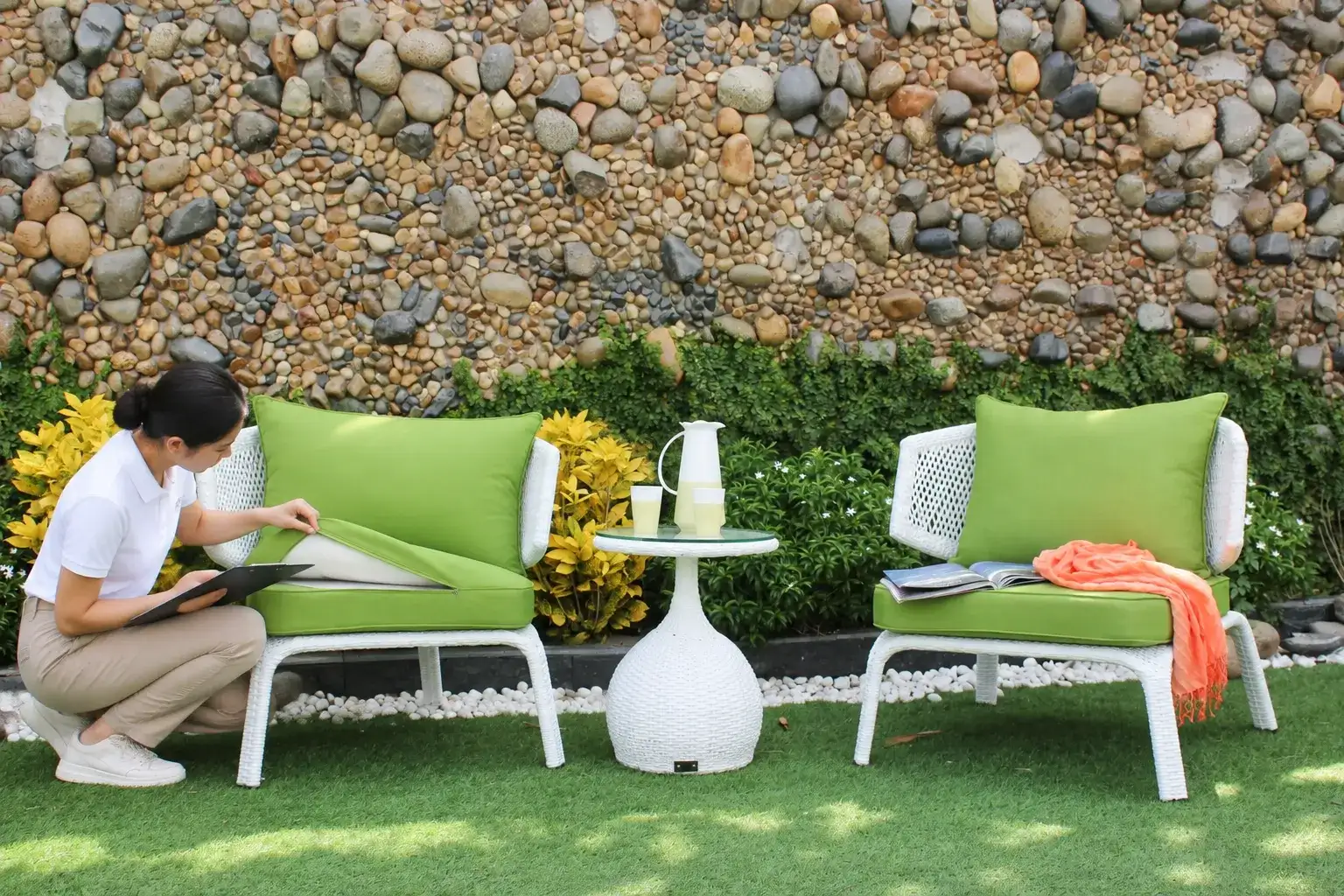
For cushioned seating, buyers should consider fabric performance, moisture management and how easily covers and cushions can be maintained.
3. How to Buy Outdoor Restaurant Tables and Chairs Wholesale
Buying outdoor restaurant tables and chairs wholesale requires a different process from purchasing individual pieces for residential use. Quantities are larger, specifications must remain consistent across multiple units, and production and logistics can significantly influence final cost.
A clear purchasing specification makes quotations easier to compare and reduces misunderstandings before production begins.
3.1 Determine Quantity, MOQ and Product Mix
Start by calculating quantities for each product category rather than simply stating the total number of furniture pieces required.
Buyers sourcing wholesale restaurant patio furniture should also ask about minimum order quantities (MOQ). MOQ may be determined by model, material, finish, production process or container quantity, depending on the manufacturer.
For container-based sourcing, mixed-model orders can be useful when a restaurant, hotel or distributor requires several product categories. However, buyers should confirm how many models, materials and finishes can practically be combined within the same production and shipment.
The product mix also affects container utilization, so quantity planning should be coordinated with packaging dimensions rather than considered separately.
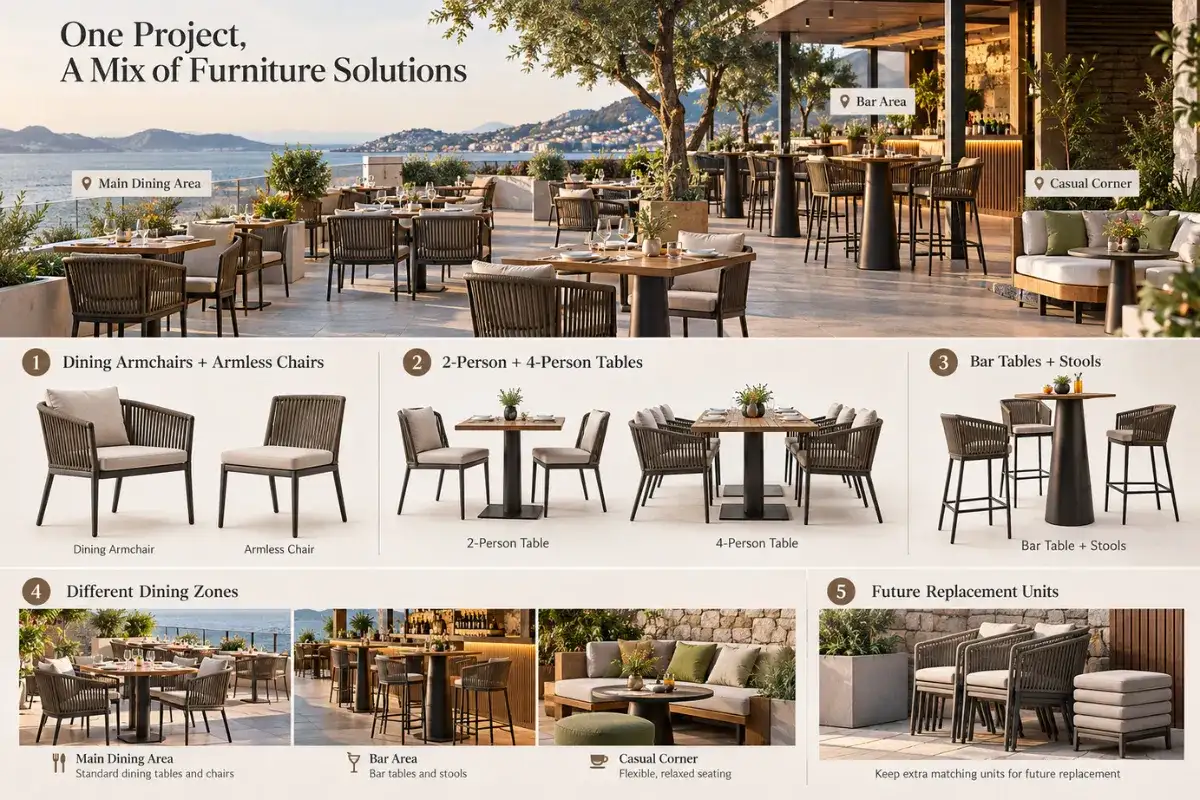
A commercial order may combine several seating and table types to support different dining zones within the same project.
3.2 Request Samples and Confirm Specifications
For custom or large-volume orders, a sample or pre-production sample provides a physical reference before mass production.
Any agreed changes should be documented before production begins.
For customized products, drawings and material swatches can provide additional references. Wicker color, rope color, fabric, frame finish and wood finish may appear different in photographs or on screens, making physical samples useful when color consistency is important to the project.
The objective is not simply to “approve a sample.” The approved specification should establish a clear reference that can also support quality control during production and final inspection.
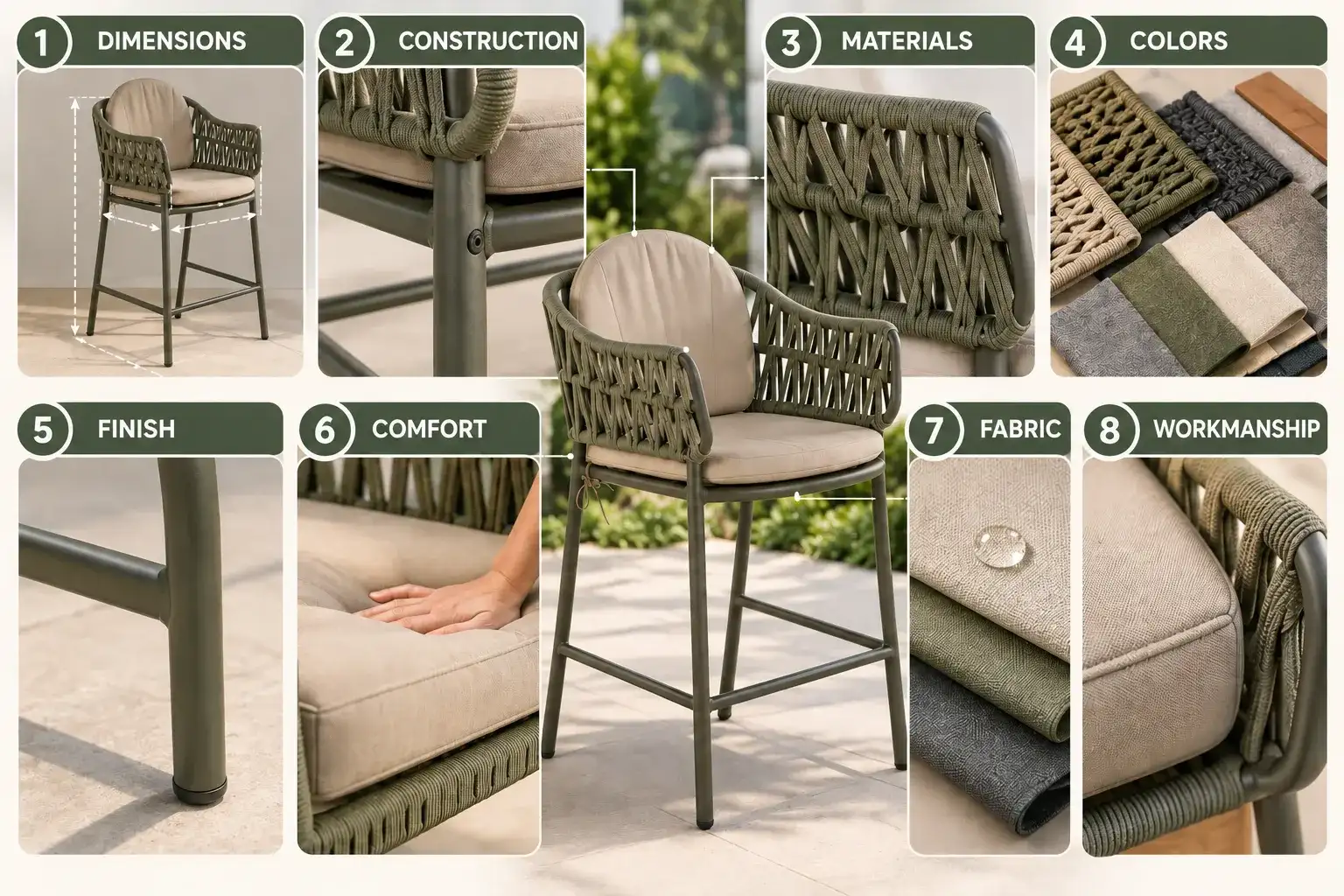
Once approved, the sample provides a clear reference for production consistency and subsequent quality control.
3.3 Compare Quotations Beyond Unit Price
The lowest quotation does not automatically represent the lowest overall sourcing cost.
Two restaurant chairs that look almost identical in photographs may use different frame specifications, materials, finishing processes, fabrics or packaging. Buyers should therefore request quotations based on the same or clearly comparable specification.
Packing efficiency is particularly relevant to imported furniture. A lower-priced assembled chair may occupy significantly more container space than an appropriately designed knock-down model, potentially changing the landed cost per unit.
Maintenance and replacement should also be considered. Furniture that is difficult to clean, store or repair can create additional operational costs after installation.
Price remains an important sourcing factor, but it is most useful when compared alongside equivalent specifications and the complete supply arrangement.
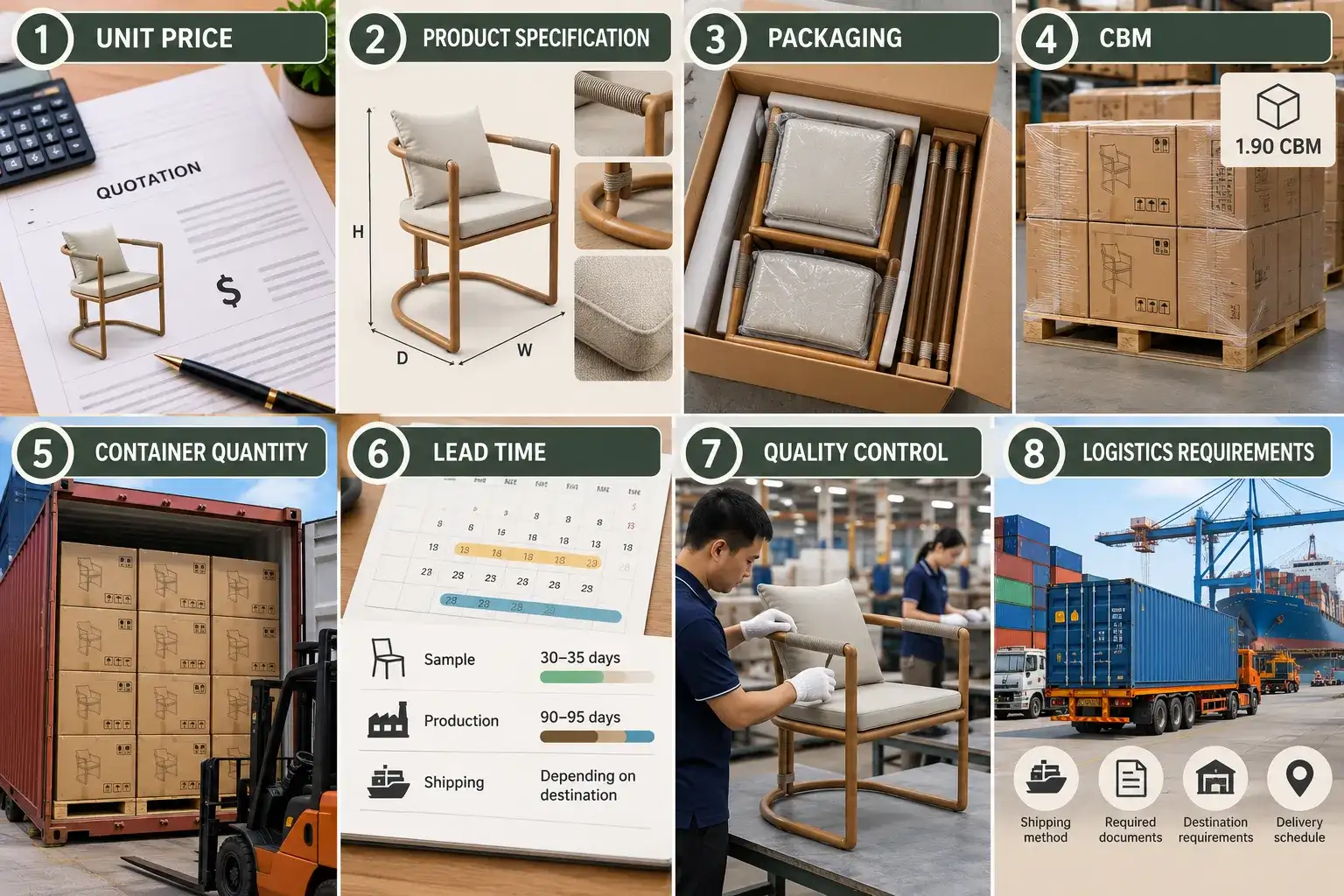
A useful quotation comparison looks beyond unit price to specifications, packing efficiency, lead time, quality control and shipping requirements.
4. How to Evaluate a Factory-Direct Restaurant Furniture Supplier
Factory-direct sourcing can provide closer communication with the manufacturer, but the term “factory direct” should not replace supplier evaluation.
Commercial buyers should verify whether a manufacturer has the production capability, quality system and export experience required for the specific project.
4.1 Evaluate Manufacturing and Customization Capability
A manufacturer does not need to be the largest factory to be suitable for a project. More importantly, when evaluating an outdoor furniture supplier, buyers should ensure that its production capabilities match the materials, construction and quantities being ordered.
For mixed-material outdoor furniture, buyers may need to assess experience with:
- aluminum frame fabrication
- powder coating
- HDPE wicker weaving
- outdoor rope
- teak or other outdoor wood
- cushion and fabric work
- assembly and finishing
Customization should also be evaluated realistically.
Changing frame color or fabric is different from developing a new furniture structure. If dimensions or construction will be modified, buyers should ask how drawings, prototypes, samples and approvals are handled before mass production.
This is particularly relevant to hospitality projects where furniture dimensions, materials and colors may need to coordinate with an existing design concept.
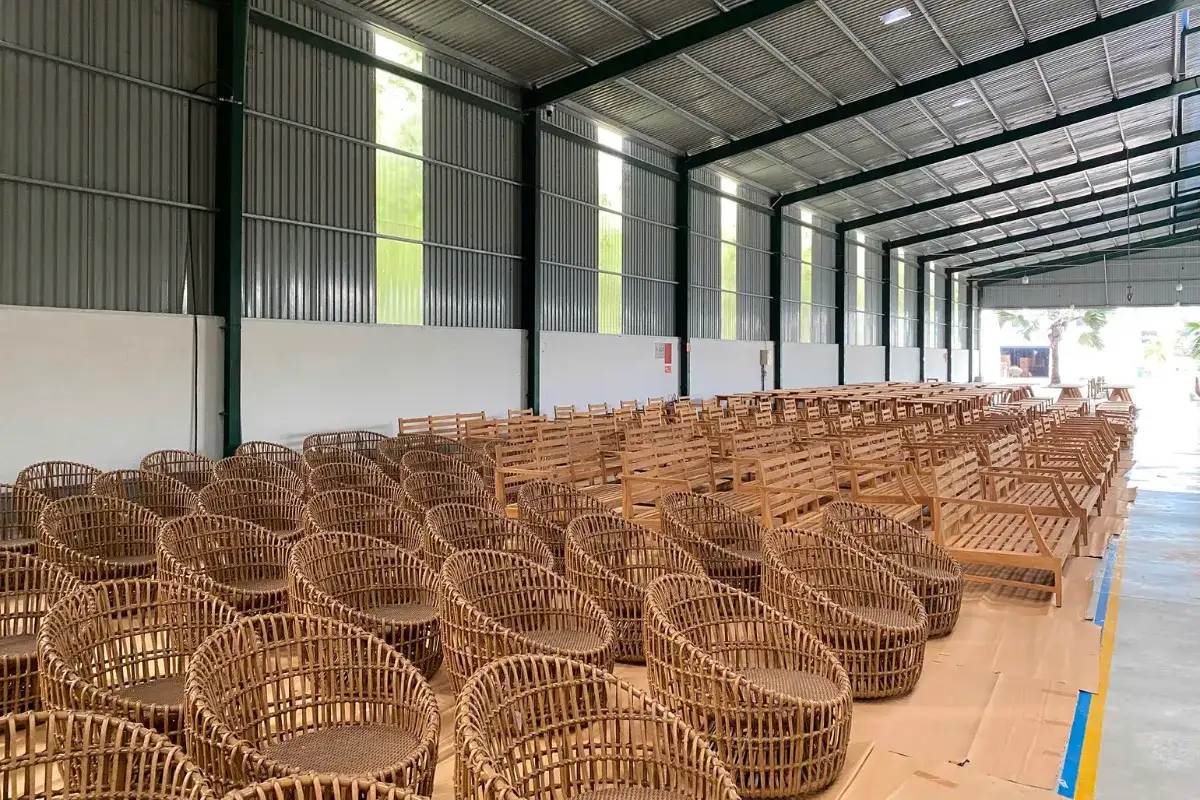
Factory capability should be evaluated across production processes, materials and customization requirements, not by scale alone.
4.2 Review Quality Control Before Mass Production and Shipment
Quality control should not be limited to inspecting finished products immediately before loading.
For example, checking frame dimensions after all products have been completed is less efficient than identifying dimensional deviations earlier in production.
Before shipment, inspection criteria can include dimensions, stability, joints and welding where applicable, surface finish, weaving, rope tension, fabric, stitching, hardware, color consistency, quantity and packaging.
For custom orders, these checks should refer back to the approved specification or sample.
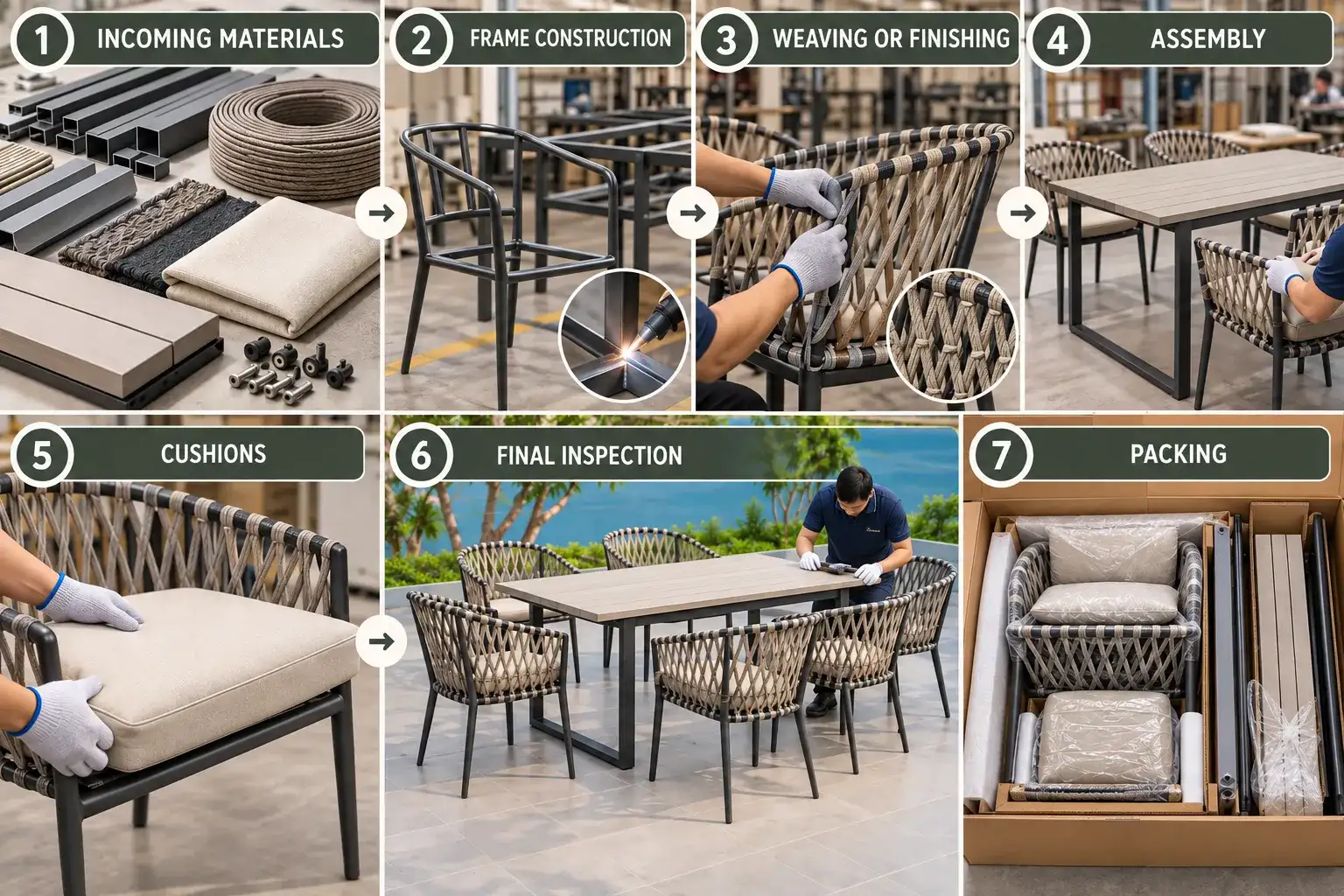
Checking quality at multiple production stages helps identify issues before they affect the finished order.
4.3 Check Packaging, CBM and Container Loading
Packaging is part of the product's journey to the project site and should be discussed before production is finalized.
Depending on the design, buyers should review carton dimensions, protective wrapping, edge or corner protection and the way individual components are secured.
Construction also affects logistics. Knock-down (KD) furniture can sometimes reduce packing volume, but it also introduces assembly requirements. The appropriate solution depends on the product and destination.
Ask the supplier to provide the CBM and estimated loading quantity for the selected products.
This information allows buyers to understand how many chairs, tables or factory direct restaurant patio sets can be loaded into a container and how different models can be combined.
Container efficiency should not override product integrity, but it can materially affect freight cost per unit.
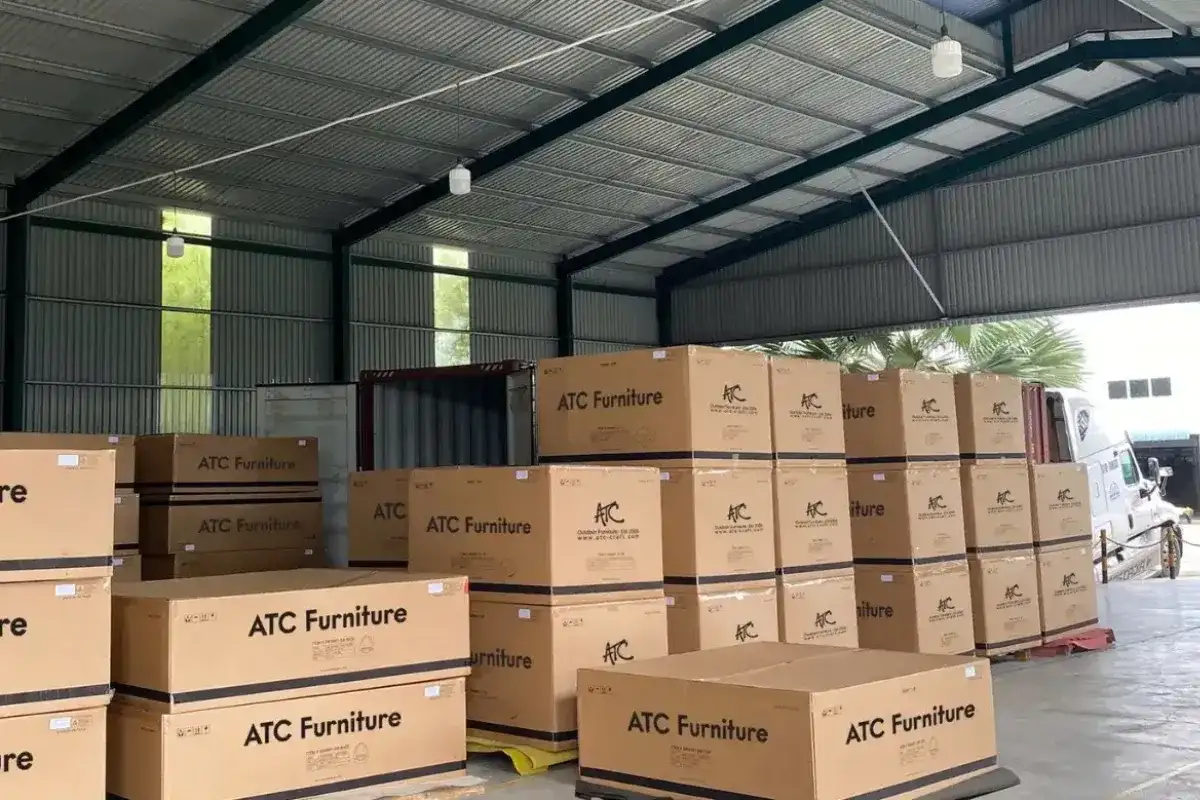
Packing design and product volume directly affect container utilization, transport planning and handling at destination.
4.4 Watch for Supplier Red Flags
Buyers should be cautious when important specifications remain unclear or change repeatedly during quotation and sampling.
Other warning signs include dimensions that have not been confirmed, unexplained material substitutions, unclear QC procedures, inconsistent sample information, or packaging and loading details that are postponed until production is nearly complete.
Lead time, packing method, approved materials and any permitted substitutions should be clarified before production.
The objective is to create a sourcing process in which the buyer and supplier are working from the same documented requirements.
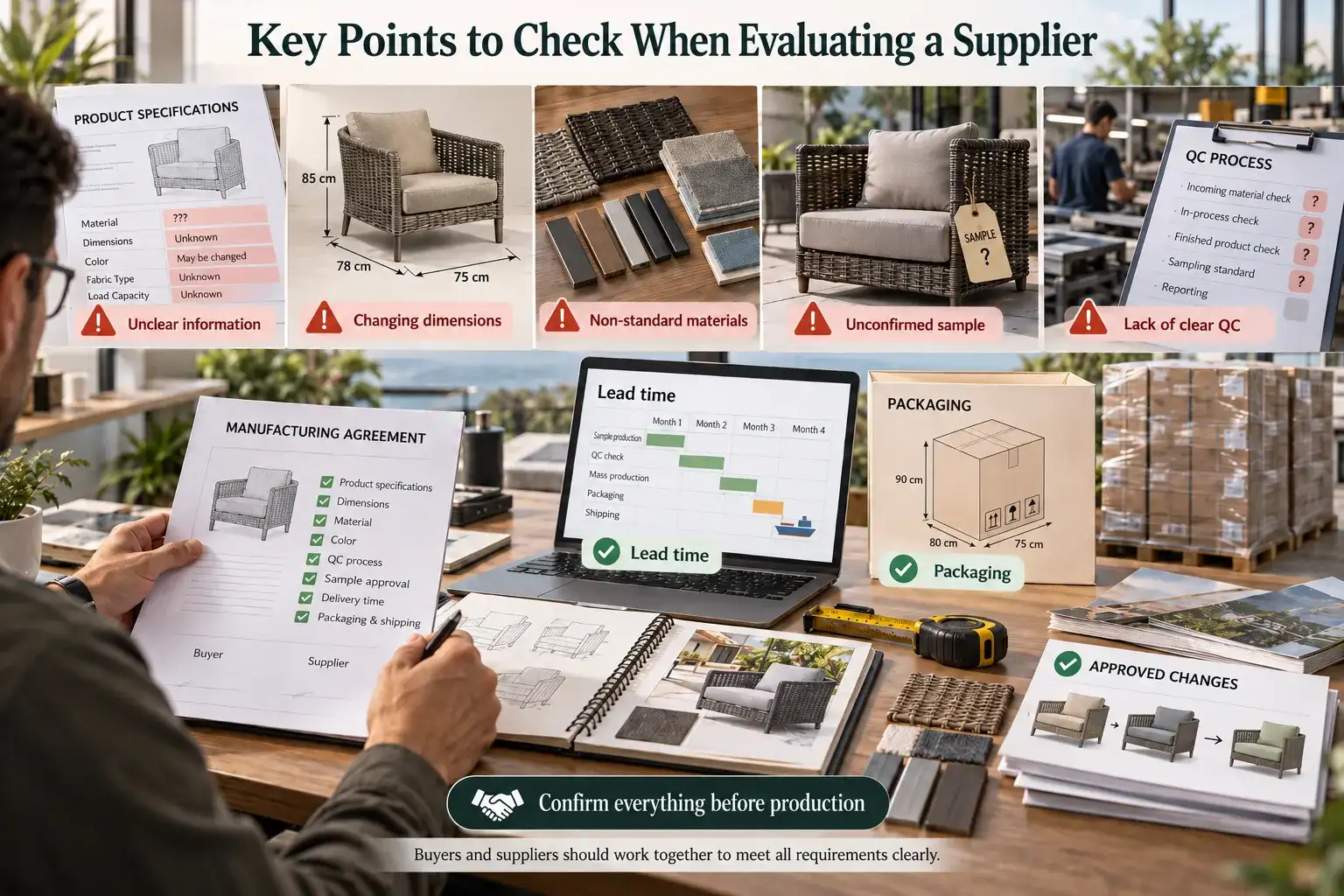
Clear documentation helps buyers and suppliers work from the same requirements throughout production and shipment.
5. Why Source Outdoor Restaurant Furniture from Vietnam?
Vietnam has an established furniture manufacturing sector serving international markets and offers access to manufacturers working with wood, metal, synthetic wicker, rope, upholstery and mixed-material furniture.
For restaurant and hospitality buyers, the relevant question is not simply whether furniture is manufactured in Vietnam, but whether a specific factory can meet the project's product, quality, customization and delivery requirements.
5.1 Vietnam as a Sourcing Base for Outdoor and Hospitality Furniture
Outdoor restaurant furniture often combines several production disciplines within one collection.
An aluminum chair, for example, may include a powder-coated frame, woven HDPE wicker or rope and an upholstered seat cushion. Another collection may combine teak with outdoor fabric.
This range of material options allows buyers to develop different aesthetics for restaurant patios, resort dining areas, cafés and other hospitality environments.
However, sourcing decisions should remain product-specific. When selecting a Vietnam outdoor furniture manufacturer, buyers should verify its experience with the required materials, construction methods and export markets rather than evaluating a supplier based only on its location.
5.2 Factory-Direct Sourcing and Customization
Working directly with a manufacturer can simplify communication when a project requires specific materials, dimensions, finishes or packaging. Buyers and factories can coordinate product specifications, drawings, material and color selections, samples, customization, production requirements, quality control, packaging and container planning more directly.
For hospitality dining furniture wholesale, this approach can be particularly useful when multiple furniture types need to maintain a consistent design across restaurants, hotels or resorts. However, factory-direct sourcing does not automatically guarantee better quality or lower total cost, so buyers should still evaluate manufacturing capability, specifications, QC procedures and logistics before placing an order.
5.3 Outdoor Restaurant Furniture from ATC Furniture
ATC Furniture is a Vietnam-based furniture manufacturer established in 2006, producing outdoor furniture for export and commercial projects.
Our outdoor furniture capabilities include powder-coated aluminum frames, HDPE synthetic wicker, outdoor rope, teak and other wood options, as well as cushions and fabric selections. Dining chairs, restaurant tables, bar furniture and coordinated outdoor collections can be developed for different commercial applications.
For projects requiring customization, buyers can discuss dimensions, materials, wicker or rope colors, frame finishes, fabrics and other product specifications before production.
ATC Furniture's standard export MOQ is one 40'HC container, with up to seven models mixed in one container, subject to product configuration and production requirements.
For a quotation, buyers can provide the required models, quantities, material preferences and destination. These details help determine specifications, packing volume, container planning and the appropriate next steps for sampling or production.
ATC Furniture supplies outdoor restaurant seating solutions for cafés, terraces, resorts and other commercial dining areas.
6. Frequently Asked Questions About Wholesale Outdoor Restaurant Furniture
6.1 What materials are best for outdoor restaurant tables and chairs?
There is no single material that is best for every restaurant. Powder-coated aluminum, HDPE wicker, outdoor rope and teak can each suit different applications. The decision should consider outdoor exposure, climate, desired appearance, maintenance capacity, furniture weight and frequency of use. Buyers should evaluate the complete construction rather than choosing by material name alone.
6.2 What should I check when buying outdoor restaurant tables and chairs in bulk?
Check the frame and joints, overall stability, seat dimensions, seat height, armrest clearance, materials, finishing, weaving or rope tension where applicable, stackability and maintenance requirements. For larger orders, confirm these specifications through drawings or samples before mass production and establish inspection criteria for the finished products.
6.3 What is the MOQ for wholesale outdoor restaurant furniture?
MOQ varies according to the manufacturer, model, material, finish and production process. Some suppliers work with model-based minimums, while others use container-based requirements. Buyers planning mixed orders should ask how many models or finishes can be combined. ATC Furniture's standard export MOQ is one 40'HC container with up to seven mixed models, subject to order configuration.
6.4 What information should I provide when requesting a wholesale quotation?
A useful RFQ should include the product or reference model, required quantity, dimensions if customized, preferred materials, colors or finishes, cushion and fabric requirements, delivery destination and target schedule. Providing these details helps the manufacturer prepare a more accurate quotation and identify any specifications that need clarification before sampling or production.
6.5 Can outdoor restaurant tables and chairs be customized?
Many manufacturers can offer customization such as frame finishes, wicker or rope colors, fabrics and cushions. Depending on production capability and order quantity, dimensions or structural details may also be modified. Structural customization normally requires more development than changing a color or fabric, so buyers should confirm drawings and samples before production.