Outdoor Furniture Supplier Checklist for Outdoor Furniture Buyers

Choosing an outdoor furniture supplier for bulk orders requires more than comparing product photos and prices. Buyers should evaluate whether the manufacturer can consistently meet requirements for quality, production capacity, lead time, documentation, and support. A practical outdoor furniture supplier checklist should cover factory capability, material sourcing, product quality, QC, samples, packaging, export experience, and pre-shipment inspection.
This is especially important when sourcing high quality outdoor furniture for hotels, resorts, commercial projects, and retail distribution, where inconsistent quality can lead to delays, claims, replacements, and additional costs.
1. Why Supplier Evaluation Matters Before Bulk Orders
Bulk outdoor furniture orders carry greater risks because quality issues across hundreds of products can be costly to correct. Buyers should therefore confirm that the supplier can reproduce approved specifications consistently throughout mass production.
This is especially important for outdoor commercial furniture used in hotels, resorts, restaurants, and cafés, where products face frequent use and need consistent quality across multiple units.
Supplier evaluation should therefore cover both the finished furniture and the manufacturing process behind it.
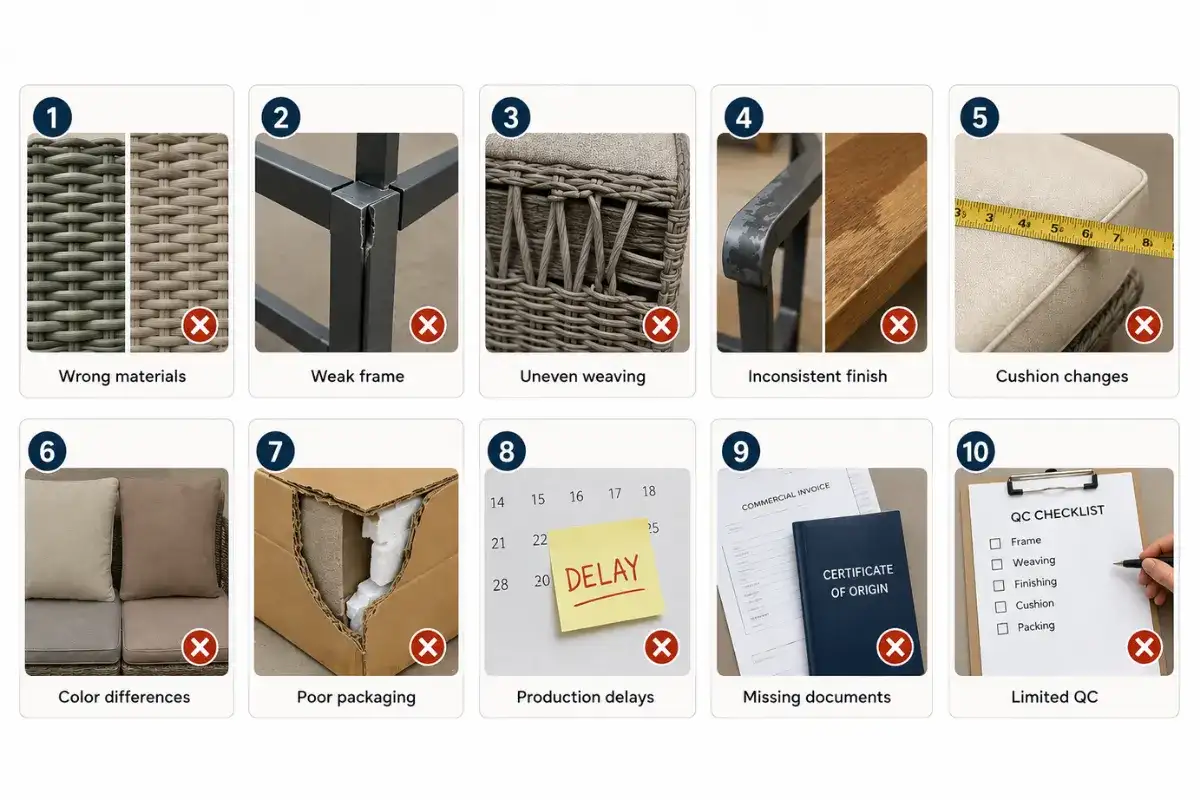
Quality and production risks when sourcing outdoor furniture in bulk.
2. Factory and Export Capability Checklist
Before reviewing individual chairs or tables, buyers should understand whether the outdoor furniture supplier has the operational capability, production system, and export experience required to handle the order.
The key question is not simply whether the factory can produce the furniture. Buyers should determine whether it can produce the required quantity consistently, within the expected lead time, and according to the approved specification.
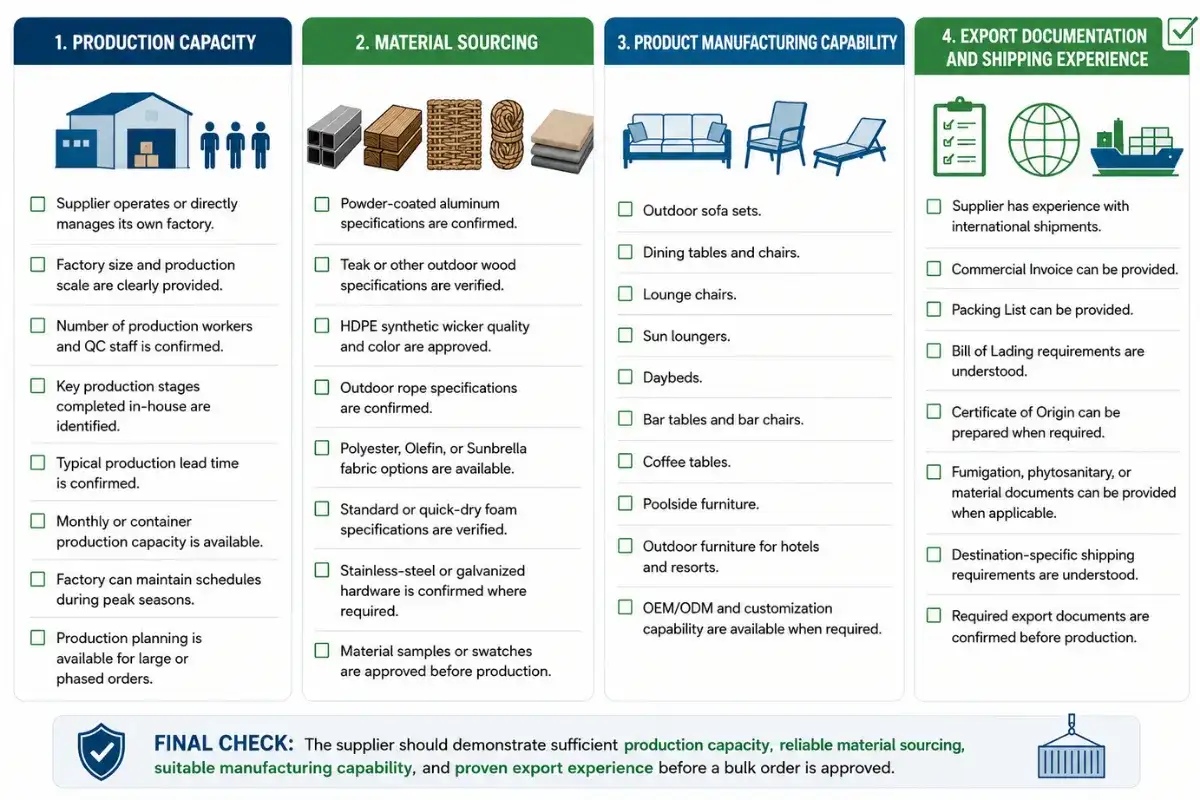
Outdoor furniture supplier factory and export evaluation checklist.
2.1 Production Capacity
Buyers should confirm that the supplier’s production capacity matches the order size by reviewing factory scale, workforce, QC staff, in-house processes, lead time, and output capacity.
For large, phased, or repeat orders, the factory should also have a clear production plan and the ability to maintain consistent quality and delivery schedules across multiple shipments.
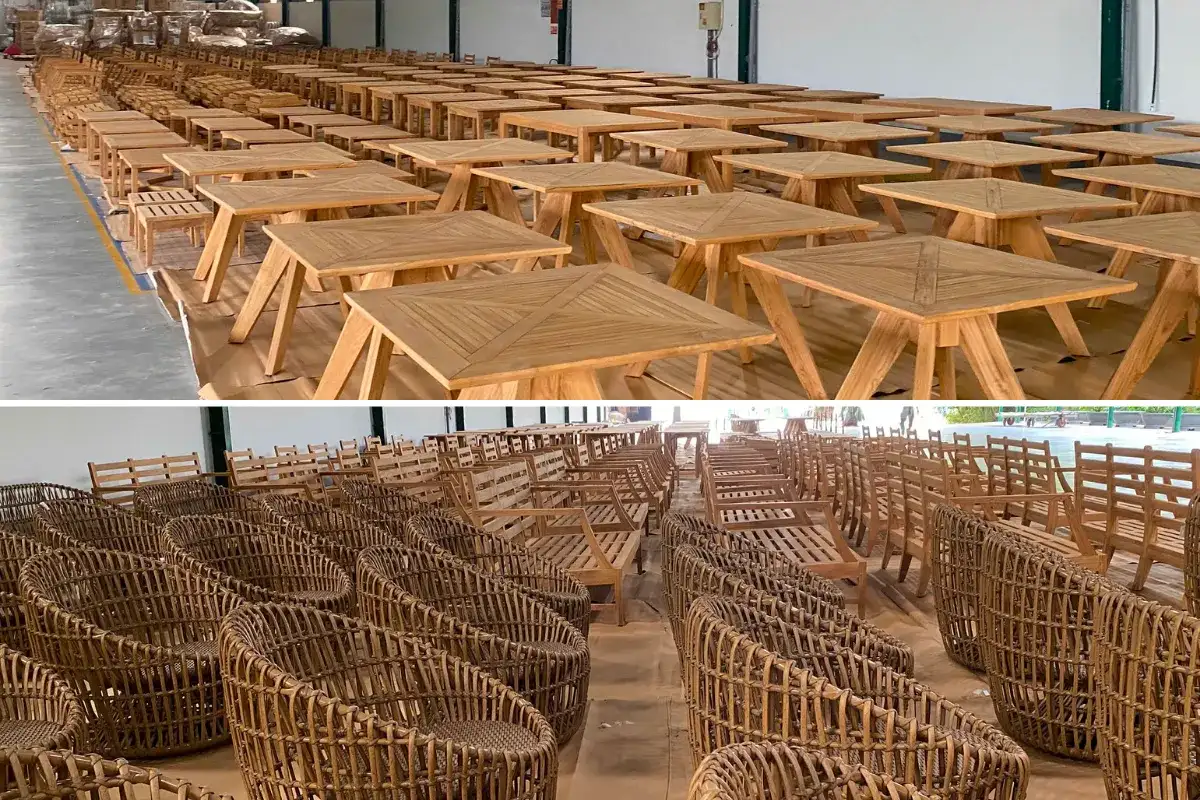
Outdoor furniture factory producing wooden tables and woven chairs in large quantities.
2.2 Material Sourcing
Outdoor furniture performance depends greatly on material quality. Buyers should verify key specifications for powder-coated aluminum, teak, HDPE synthetic wicker, outdoor rope, outdoor fabrics, foam, and hardware.
Rather than relying on general terms such as “premium quality” or “weatherproof,” buyers should confirm measurable details. For example, wicker specifications should cover material, color, profile, UV resistance, and weaving, while aluminum frames should include dimensions, wall thickness, welding quality, and powder coating.
Material swatches or samples can also help ensure consistent color and texture during bulk production.
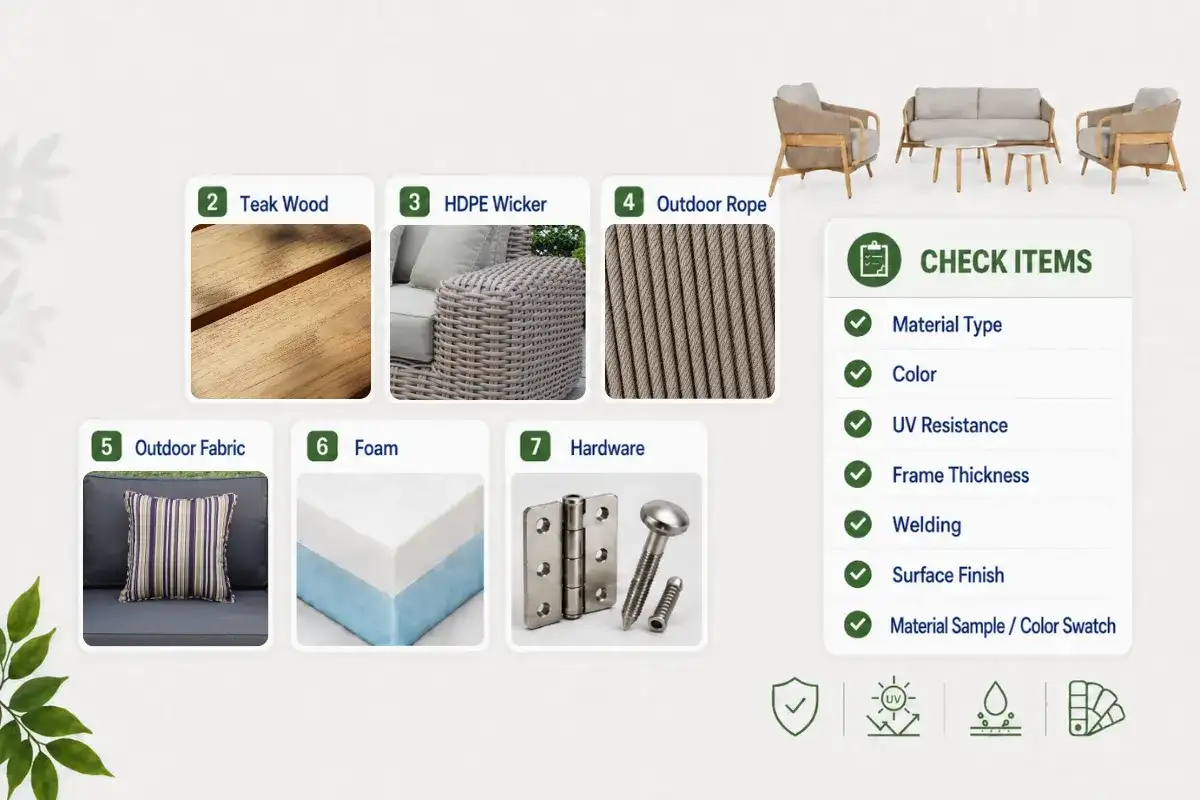
Buyers should verify measurable material specifications rather than relying on general claims such as premium quality or weatherproof.
2.3 Product Categories and Manufacturing Capability
A specialized outdoor furniture manufacturer should have proven experience across relevant product categories, such as sofa sets, dining furniture, lounge chairs, sun loungers, swing chairs, daybeds, bar furniture, coffee tables, and poolside collections.
For hotel outdoor furniture and outdoor contract furniture, buyers should also assess customization capabilities for dimensions, materials, colors, fabrics, and construction details. OEM and ODM services are particularly valuable for exclusive collections and hospitality projects with specific design requirements.
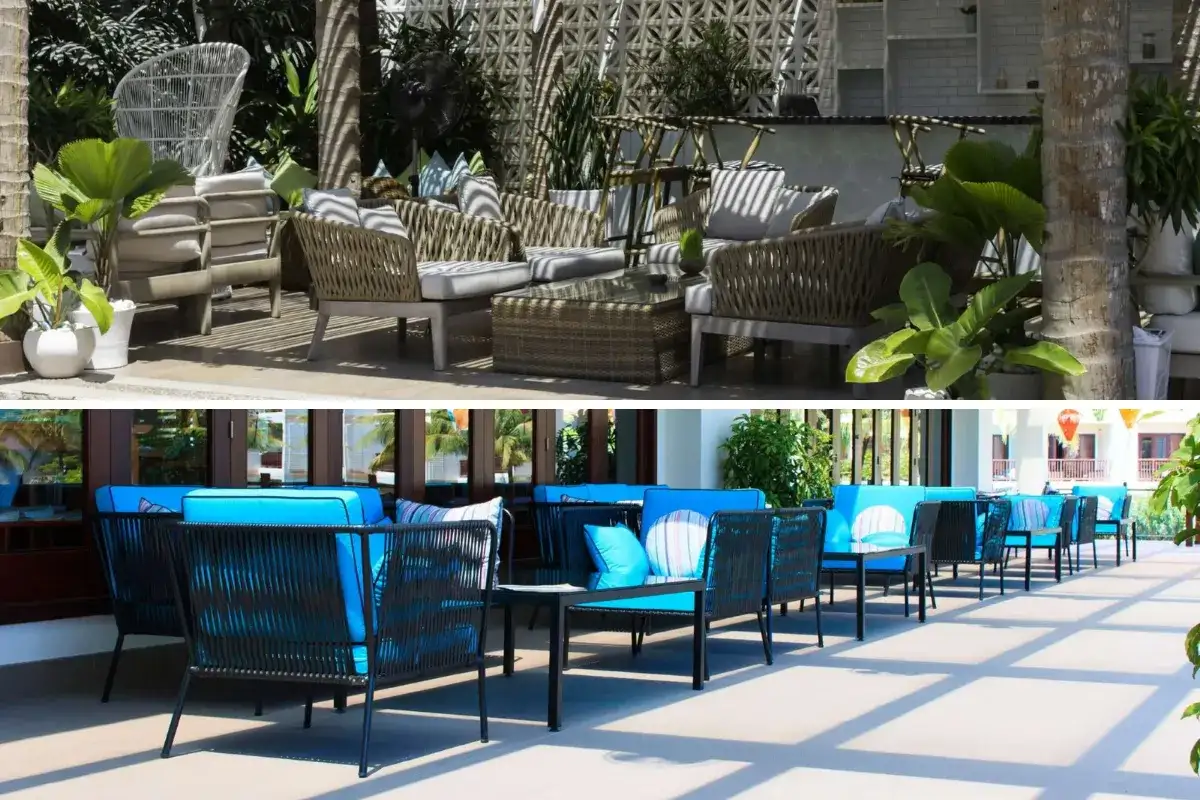
A broad product range demonstrates a supplier’s ability to support different outdoor furniture requirements for hospitality projects.
2.4 Export Documents and Shipping Experience
For international orders, manufacturing capability should be supported by export experience. Suppliers should understand common requirements such as commercial invoices, packing lists, bills of lading, certificates of origin, and other shipment or material documents when applicable.
Buyers should confirm all required export documents before production to avoid delays when the order is ready to ship.
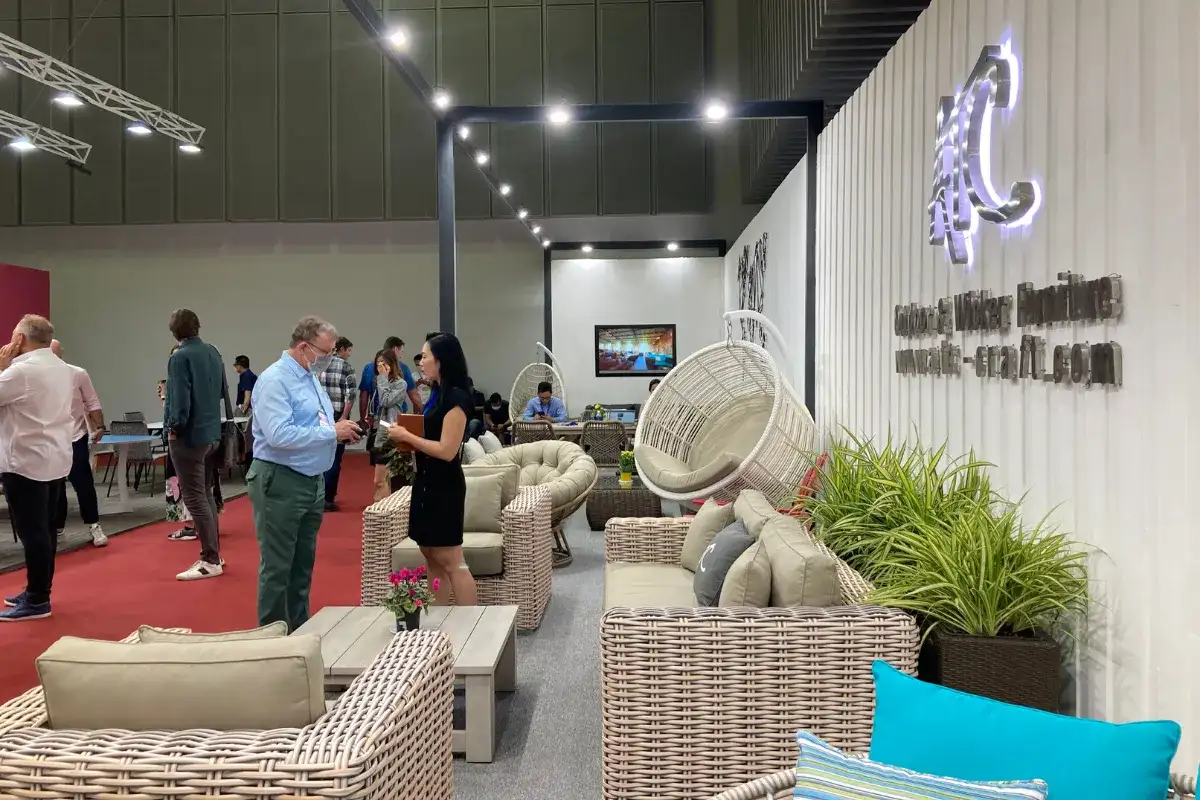
International trade shows reflect a supplier’s experience in working with overseas buyers and serving export markets.
3. Product Quality Checkpoints
After reviewing factory capability, buyers should evaluate the product itself. Quality inspection should focus on key components rather than appearance alone.
The five main checkpoints are frame construction, weaving quality, surface finishing, cushion specifications, and outdoor durability. Together, these factors determine product stability, appearance, maintenance needs, and long-term performance.
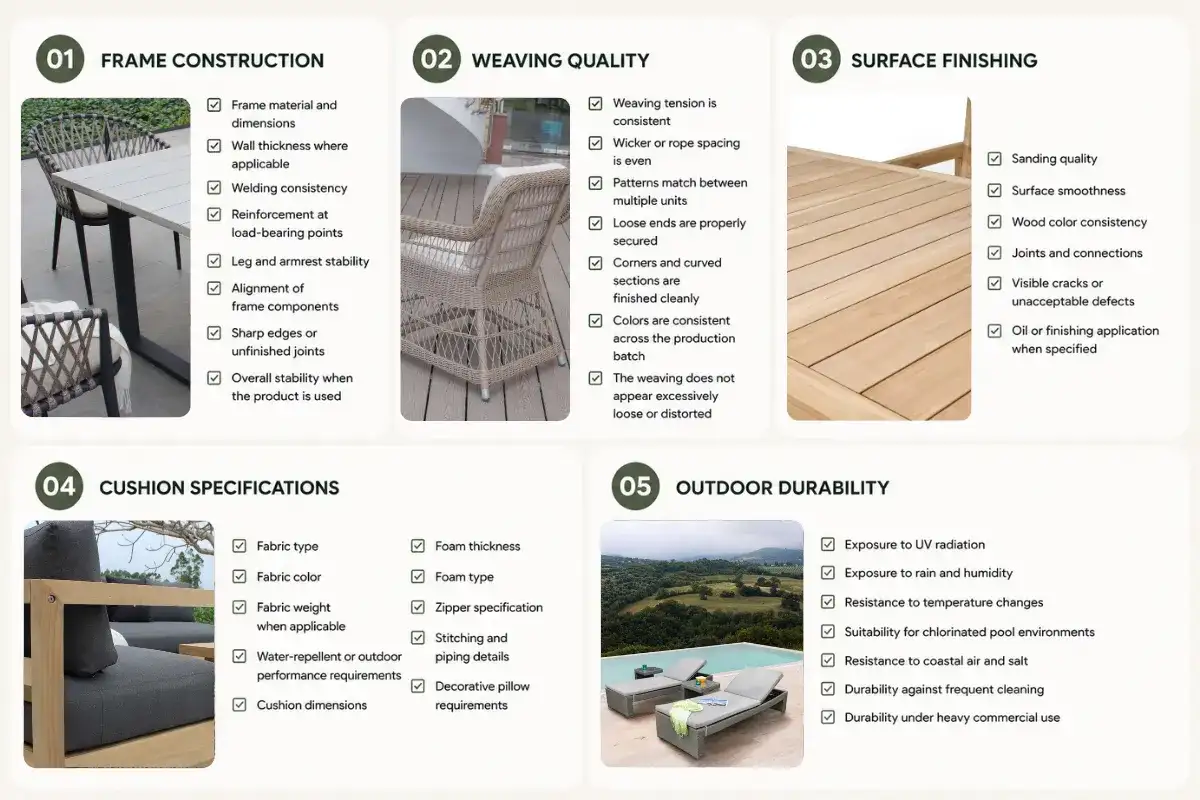
Key quality control points for inspecting outdoor furniture products.
3.1 Frame Strength
The frame is the structural foundation of outdoor furniture, so buyers should check the material, dimensions, wall thickness, welding, reinforcement, alignment, and overall stability.
For aluminum furniture, the powder coating should be even and free from peeling, bubbling, exposed metal, or major color differences. The finished product should also remain stable without excessive rocking during normal use.
3.2 Weaving Quality
For HDPE wicker and outdoor rope furniture, weaving quality affects both appearance and durability. Buyers should check weaving tension, spacing, pattern consistency, secured ends, clean corners, and uniform color across the production batch.
This is especially important for commercial outdoor furniture chairs, where small inconsistencies become more noticeable when many identical units are placed together.
3.3 Finishing
Surface finishing should match the material and remain consistent across the order. For powder-coated metal, buyers should check coating quality and visible defects, while teak or other wood should be inspected for smooth sanding, consistent color, secure joints, and cracks.
Finished products should also be free from scratches, stains, exposed welds, sharp edges, adhesive residue, and other workmanship defects.
3.4 Cushion Specifications
Cushion specifications should clearly define the fabric, color, weight, outdoor performance, dimensions, foam type and thickness, zipper, stitching, piping, and decorative pillows.
For poolside or high-moisture areas, quick-dry foam may be more suitable. Final cushions should also be compared with the approved sample to confirm consistent shape, thickness, firmness, and color.
3.5 Outdoor Durability
Outdoor furniture must perform under different environmental conditions, from covered balconies to poolside and coastal areas. Buyers should consider UV exposure, rain, humidity, temperature changes, chlorine, salt air, frequent cleaning, and heavy commercial use.
Material specifications should therefore match the intended environment. Instead of relying on broad claims such as “100% weatherproof,” buyers should verify the materials and construction methods used to support long-term outdoor performance.
4. Sample Review and Pre-Shipment Inspection
A sample helps reduce sourcing risk, but approval does not guarantee that bulk production will automatically meet the same standard.
Before production, buyers should check key dimensions, materials and colors, construction quality, comfort, and packaging requirements. Once approved, the sample and specification sheet can serve as a golden sample for production reference.
Before shipment, a pre-shipment inspection should verify quantity, dimensions, frame stability, weaving, finishing, cushions, colors, accessories, labels, and packaging. Photos and videos can also provide useful quality records.
The key principle is: sample approval sets the standard; pre-shipment inspection confirms whether bulk production meets it.
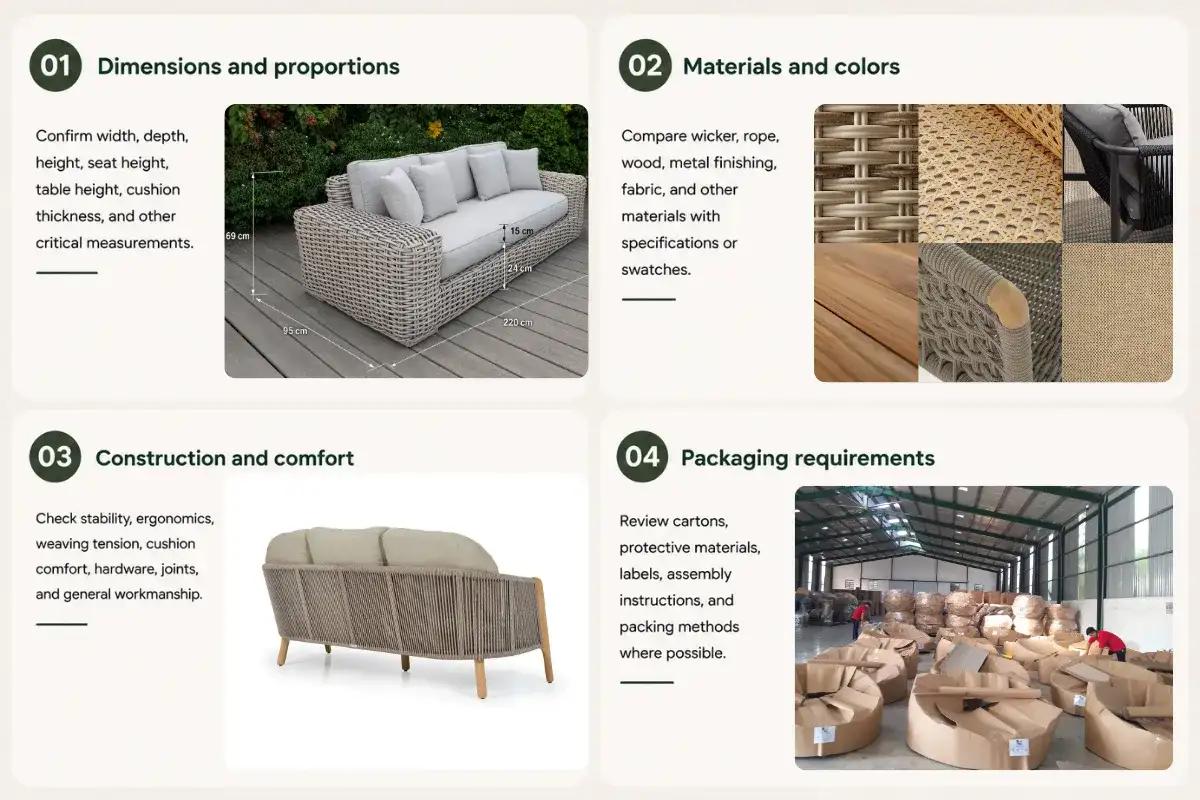
A detailed sample review helps buyers confirm critical product specifications before approving large-scale production.
5. Red Flags Buyers Should Avoid
Not every supplier issue is immediately visible in a quotation. Buyers should pay attention to warning signs that may indicate greater sourcing risk.
Common red flags include:
- Unclear factory information: The supplier cannot clearly explain where or how the products are manufactured.
- Vague material specifications: Materials are described only as “high quality” or “premium” without measurable specifications.
- Unusually low quotations: A significantly lower price may result from different materials, construction, finishing, or packaging and should be investigated before comparing offers.
- No written production specification: Important details are discussed verbally but are not recorded in quotations, specification sheets, drawings, or approved samples.
- Constantly changing lead times: Production schedules change repeatedly without clear explanations.
- Limited QC procedures: The supplier cannot describe how quality is checked during production.
- Resistance to inspection: Buyers are discouraged from inspecting products or using third-party inspection services.
- Inconsistent communication: Important questions about materials, production, or shipment receive incomplete or contradictory answers.
- Unclear packaging standards: Packaging is discussed only after production has been completed.
One warning sign alone does not necessarily mean a supplier is unsuitable. However, several unresolved issues can indicate a higher probability of quality, delivery, or communication problems during a bulk order.
6. How to Use the Checklist When Comparing Suppliers
Once information is collected, buyers should compare suppliers systematically using a weighted scorecard rather than focusing on price alone. Each supplier can be scored by product quality, production capacity, QC, lead time, export experience, and support.
The weighting can vary by buyer type. Hotels and resorts may prioritize durability and delivery reliability, while distributors may focus more on production capacity and repeat-order consistency.
Price should always be reviewed together with specifications. Two quotations for the same contract outdoor furniture may differ in aluminum thickness, wicker quality, fabric, cushions, packaging, or QC standards.
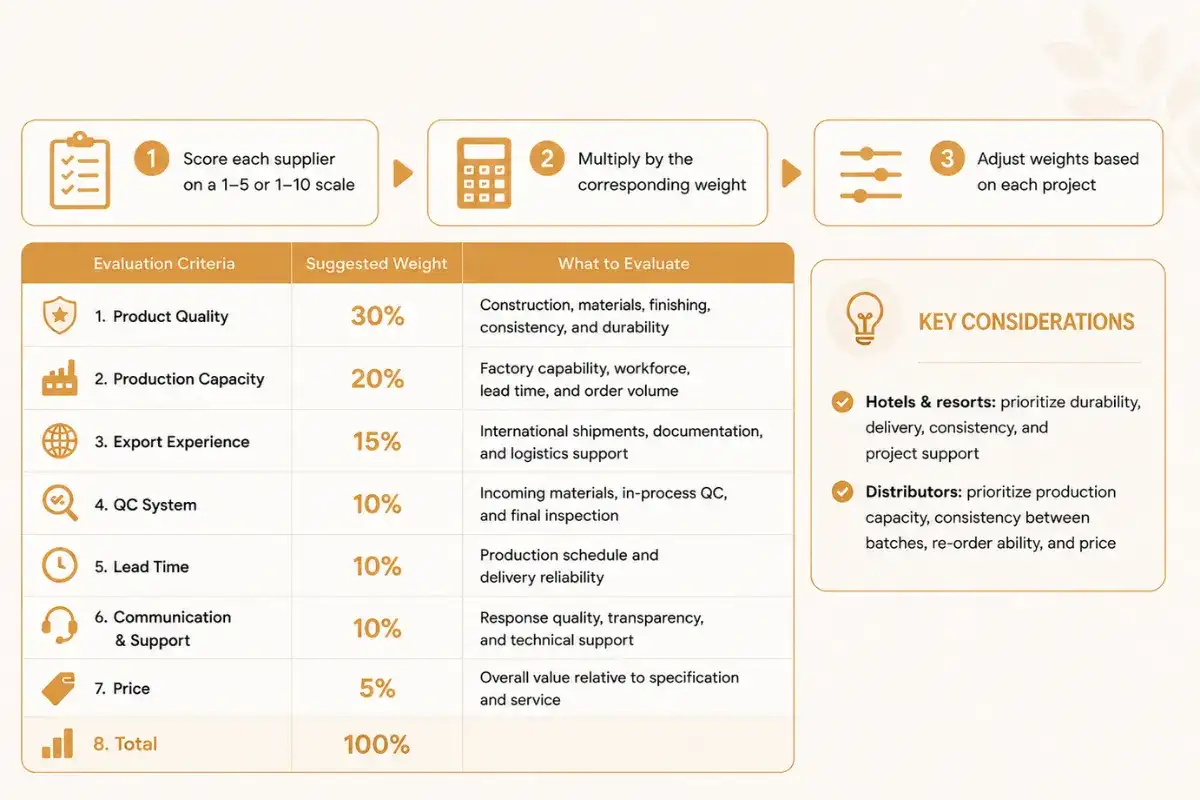
B2B outdoor furniture supplier comparison checklist for buyers with scoring and evaluation weights.
The most useful supplier comparison is therefore not: Which supplier has the lowest price?
It is: Which supplier can consistently deliver the required specification, quantity, quality, lead time, and support at an acceptable total cost?
7. Frequently Asked Questions
7.1 What should buyers check when choosing an outdoor furniture supplier?
Buyers should evaluate the supplier’s factory capacity, production experience, material sourcing, frame construction, weaving or finishing quality, cushion specifications, QC system, lead time, export experience, packaging standards, and ability to support pre-shipment inspection. A complete outdoor furniture supplier checklist should assess both the finished product and the manufacturing process behind it.
7.2 How can buyers verify the quality of outdoor furniture before placing a bulk order?
The most effective approach is to review material specifications, request samples, confirm dimensions and construction details, and establish an approved sample or specification sheet before mass production. Buyers should also conduct a pre-shipment inspection to verify that bulk production matches the approved requirements for materials, workmanship, colors, cushions, packaging, and overall product quality.
7.3 What is most important when comparing outdoor furniture suppliers?
Product quality and production capability should generally receive more weight than price alone. Buyers should compare suppliers based on quality consistency, manufacturing capacity, QC systems, export experience, lead time, communication, and total value. For outdoor commercial furniture and hospitality projects, durability, repeat-order consistency, and reliable delivery are particularly important.