Luxury Resort Outdoor Furniture: High-End Materials, Custom Specs & Commercial Layouts
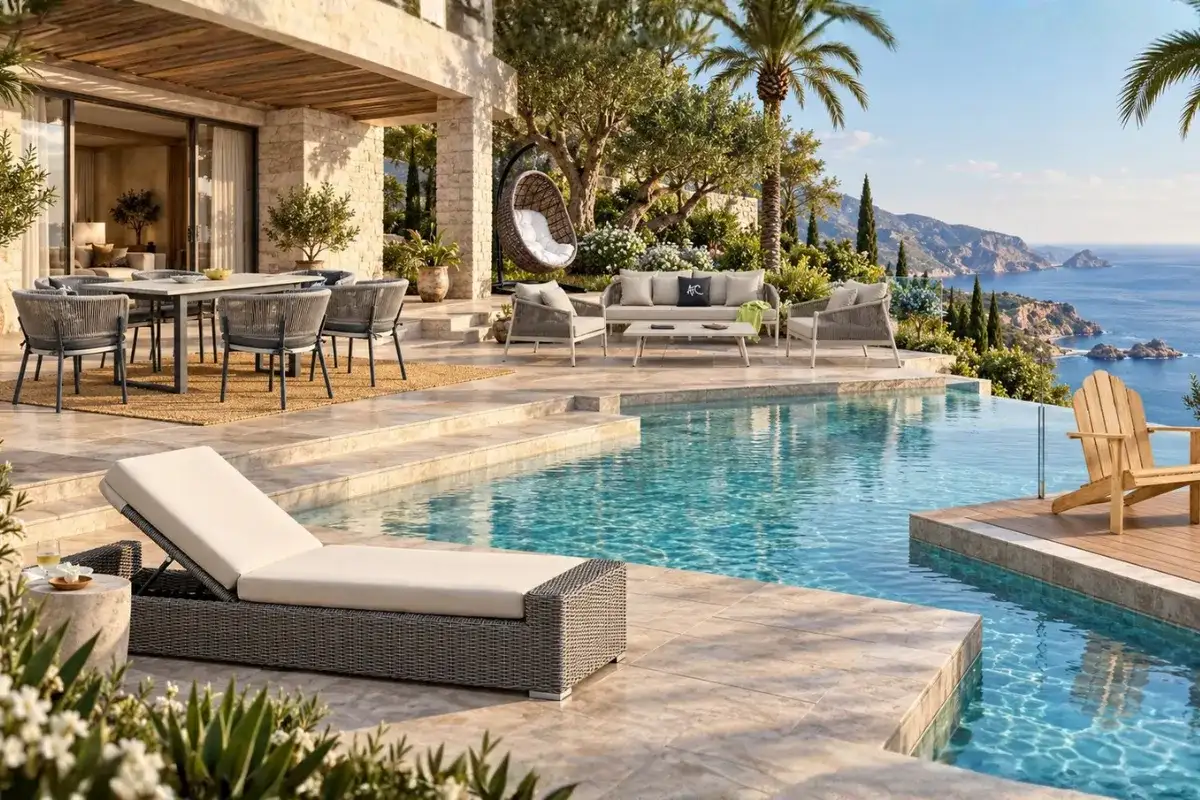
Luxury resort outdoor furniture has become an important part of how premium hospitality spaces are designed and experienced. Pool decks, beachfront lounges, rooftop terraces, restaurants, private villas, and balconies are no longer treated as secondary areas. In many high-end properties, these spaces contribute directly to the visual identity of the resort and shape how guests interact with the environment.
For buyers, designers, developers, and purchasing teams, sourcing furniture for these areas requires more than selecting attractive products. Furniture needs to support the architectural concept, provide appropriate comfort, work within commercial layouts, and coordinate across multiple guest-facing spaces. Depending on the project, dimensions, colors, weaving patterns, fabrics, finishes, and material combinations may also need to be customized.
This makes sourcing luxury resort outdoor furniture less about selecting individual pieces and more about developing a coordinated collection that works visually, functionally, and commercially across the property.
1. What Defines Luxury Resort Outdoor Furniture?
Luxury outdoor furniture is not defined by price alone. In hospitality environments, perceived quality comes from the relationship between design, comfort, proportion, materials, detailing, and the surrounding architecture. A well-designed product should feel intentional within the space rather than appearing as an isolated decorative object.
1.1 A Consistent Design Language
A successful resort collection should reflect the identity of the property. A tropical resort may use natural textures, warmer wood tones, woven surfaces, and softer forms, while a contemporary city hotel may prefer cleaner silhouettes, slimmer frames, restrained colors, and more architectural proportions.
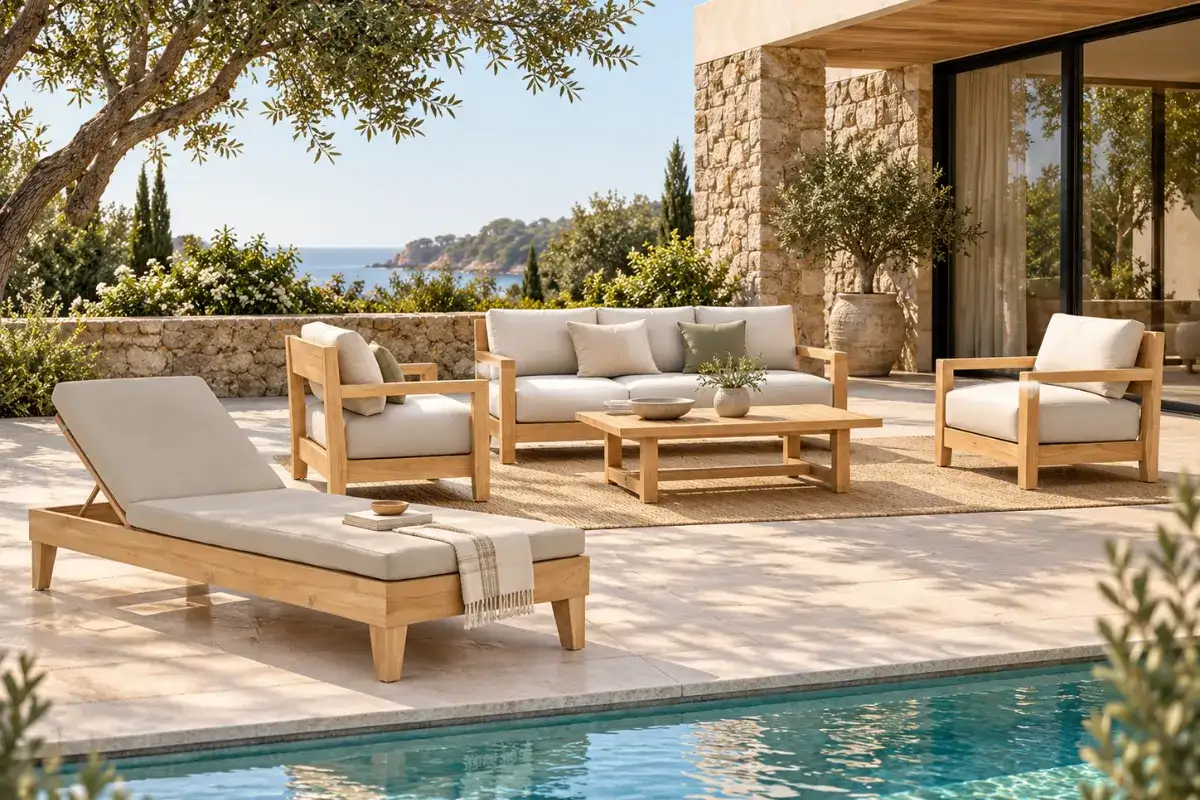
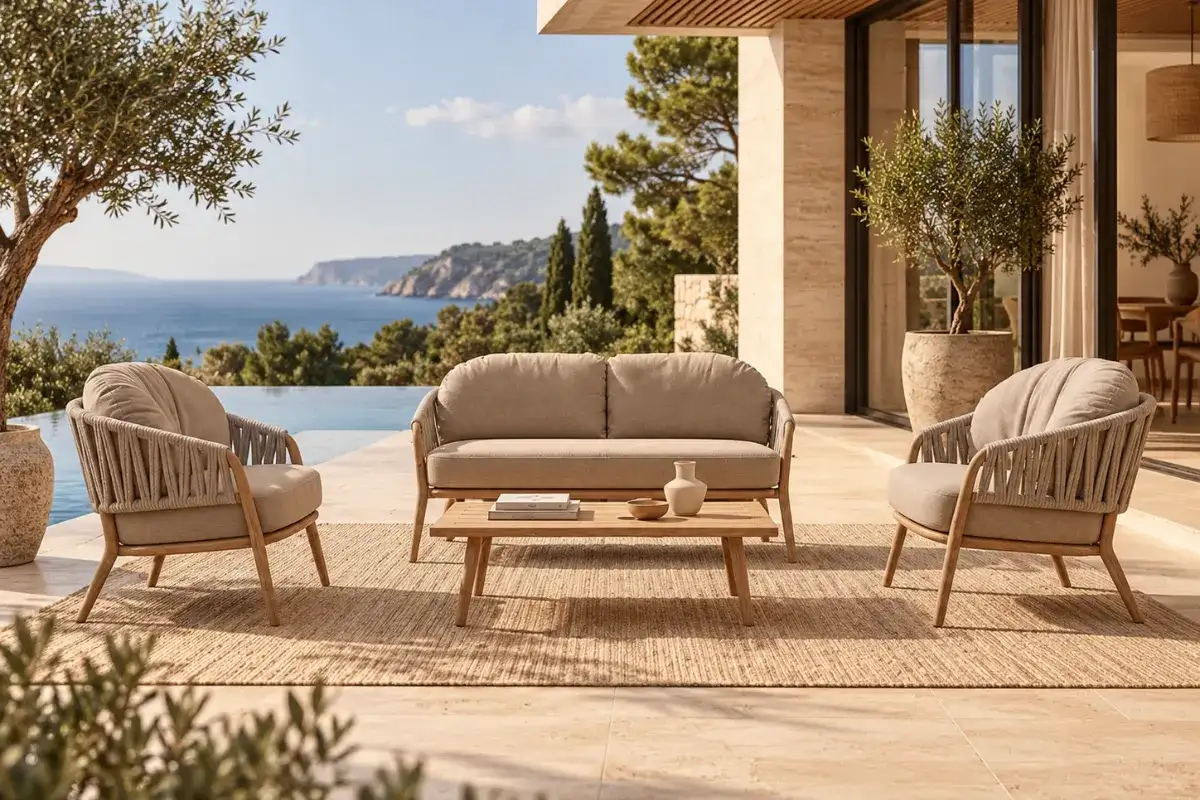
Matching wood tones, neutral cushions, and clean silhouettes create a consistent design language across resort outdoor spaces.
Different areas may require loungers, dining chairs, sofas, bar stools, coffee tables, daybeds, and balcony sets, but these products should still feel related. Repeated frame profiles, coordinated fabrics, complementary weaving patterns, and controlled material combinations can create a unified design language without requiring every space to use identical furniture.
This is particularly important when sourcing luxury hotel outdoor furniture across several guest-facing areas. Designing each zone independently can result in a fragmented appearance even when individual products are visually refined.
1.2 Comfort as Part of the Luxury Experience
Comfort is a direct part of the guest experience. Seat depth, cushion thickness, backrest angle, seat height, armrest position, and table proportions all influence how furniture performs in use.
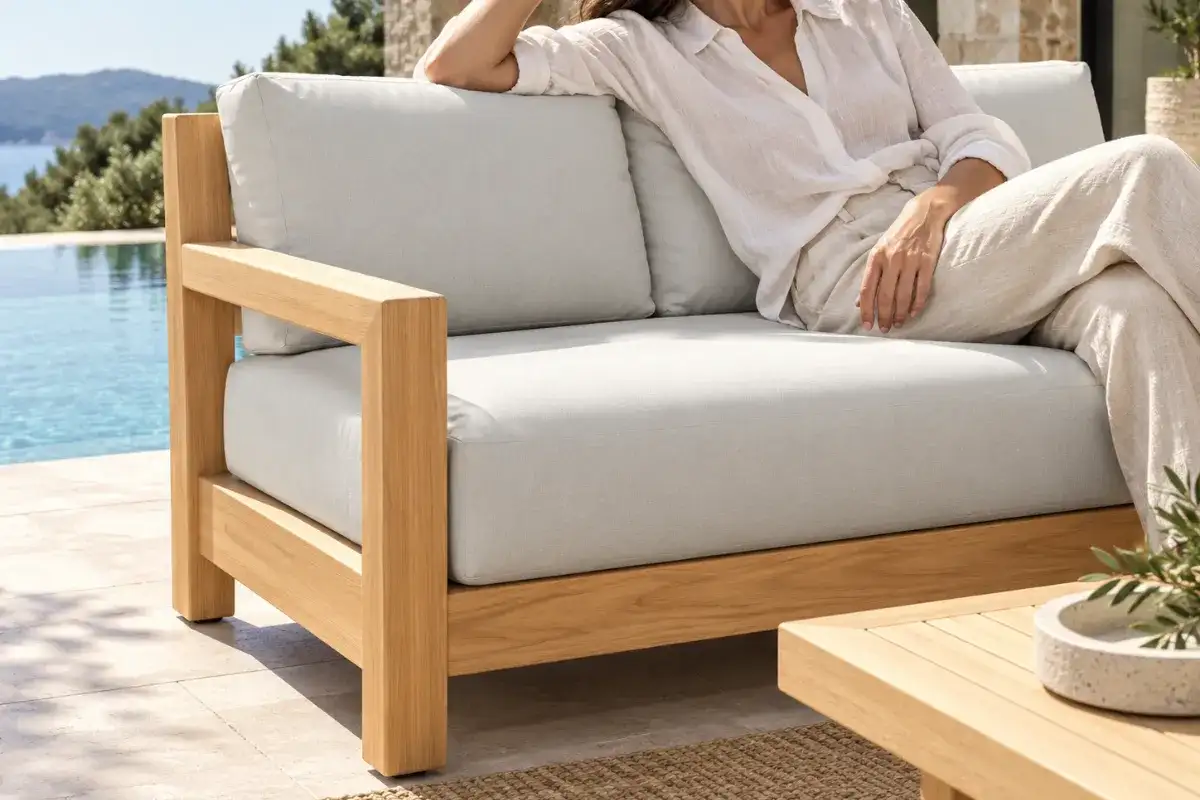
Deep seating, generous cushions, and supportive armrests provide lasting comfort for guests enjoying outdoor resort spaces.
Lounge products often use deeper seating and more generous cushions, but larger dimensions do not automatically create better comfort. An oversized sofa can feel awkward if the proportions are unbalanced, while a bulky dining chair may restrict circulation or make service more difficult.
Comfort should therefore be evaluated according to the intended use of each area. Poolside seating, restaurant furniture, rooftop lounges, and private villa terraces require different levels of support, seat proportions, and sitting positions.
1.3 Refined Details and Finishing
Premium furniture is often distinguished by smaller details rather than excessive decoration. Clean welding, controlled weaving tension, consistent seams, refined edges, well-fitted cushions, smooth material transitions, and carefully finished surfaces can all contribute to a more sophisticated appearance.
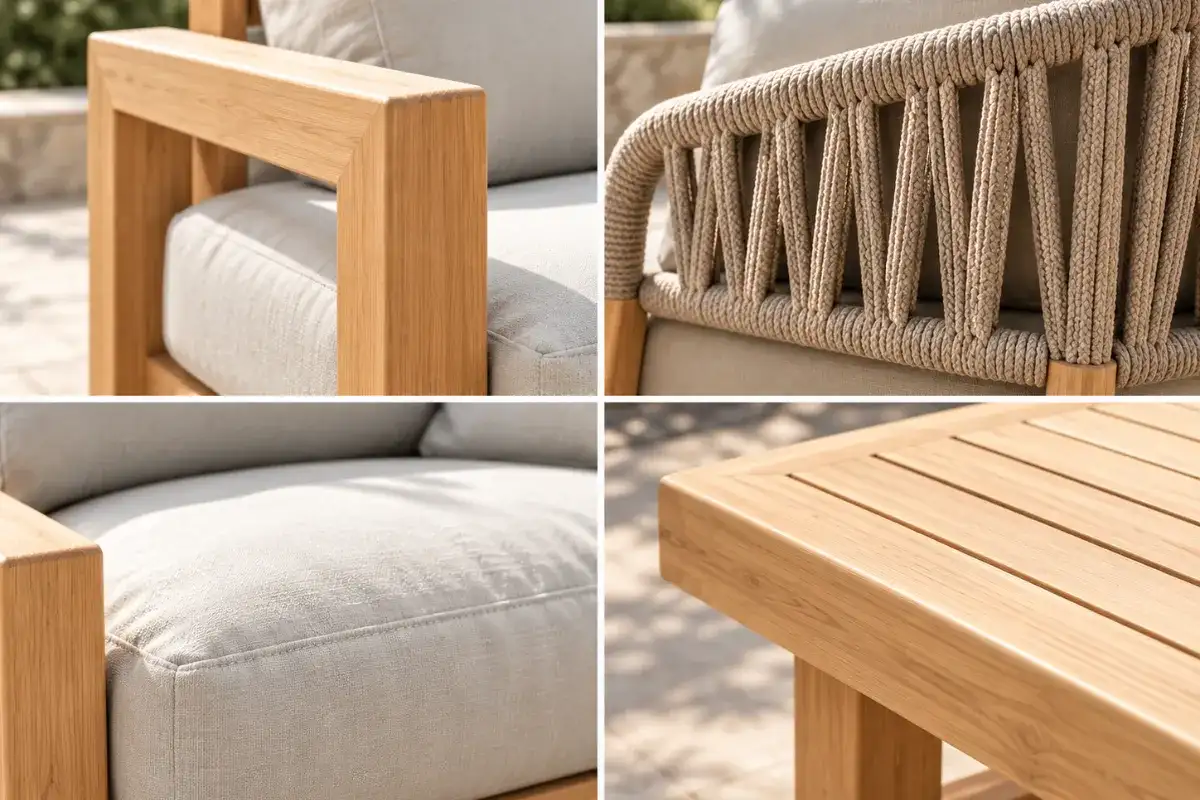
Smooth wooden surfaces, precise stitching, and consistent rope weaving reflect the attention to detail in premium outdoor furniture.
These details become especially visible when the same product is repeated throughout a property. A minor inconsistency may be difficult to notice on one chair but becomes more apparent when multiple units are installed side by side.
For hospitality projects, quality should therefore be evaluated not only on an individual sample but also on how consistently the approved standard can be reproduced.
2. High-End Materials and Custom Specifications
Material selection strongly influences the character of high end commercial outdoor furniture. Premium collections often combine several materials to create visual depth while keeping the palette controlled enough to remain cohesive across the property.
Natural wood, woven rope, and soft cushions create a balanced material palette for luxury resort outdoor spaces.
2.1 Selecting Materials for a Luxury Collection
Powder-coated aluminum is commonly used as a structural base and can be combined with teak, synthetic wicker, outdoor rope, performance fabrics, and different tabletop materials. In premium applications, however, the final impression depends on more than the material name. Frame proportions, weld finishing, coating consistency, reinforcement, and transitions between materials all affect perceived quality.
Teak introduces natural warmth and can connect furniture visually with tropical landscaping and architectural finishes. It may be used for complete frames or selected details such as armrests, tabletops, inserts, and accents. Buyers should also consider how the wood is expected to change over time and whether the project intends to preserve a particular tone.
Outdoor rope and synthetic wicker add texture and are widely used in designer resort patio furniture. In refined collections, weaving quality is particularly visible. Spacing, tension, alignment, edge finishing, and transitions around corners should remain controlled from one unit to another.
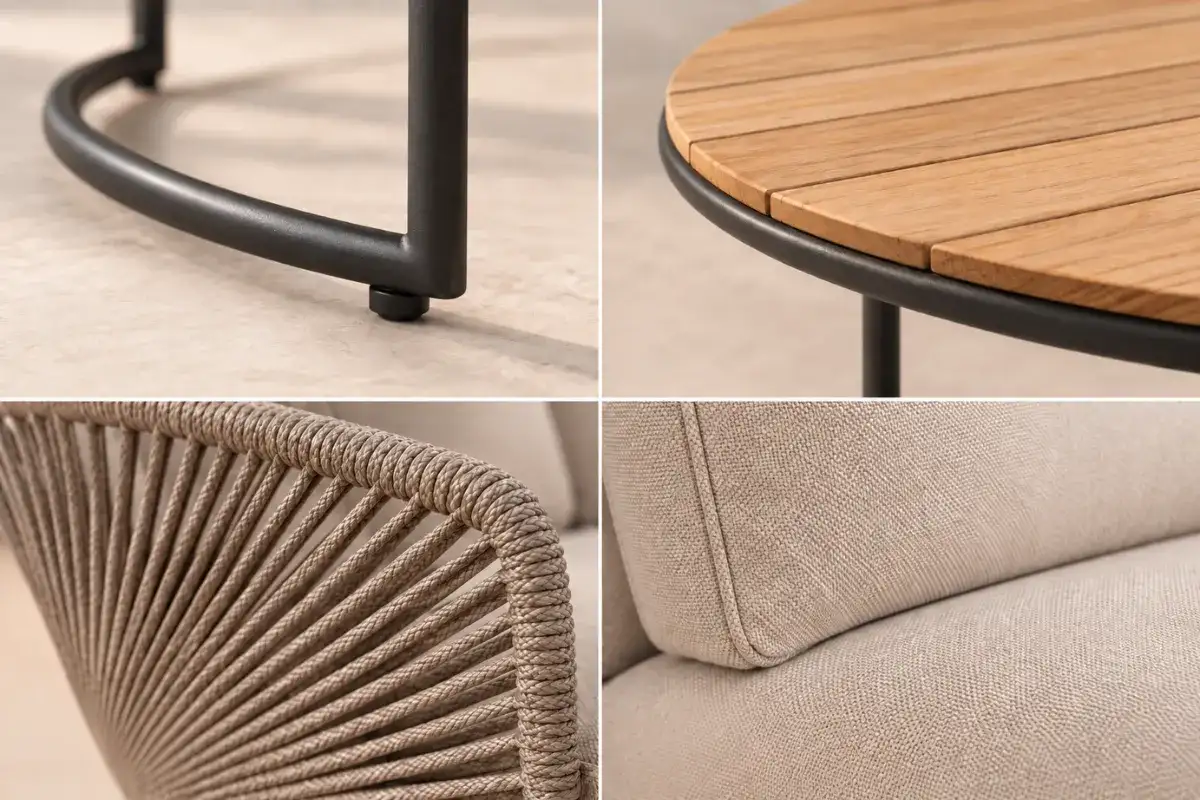
Powder-coated aluminum, natural wood, woven rope, and performance fabrics combine durability with refined design for luxury resorts.
Performance fabrics complete the composition. Color and texture influence the visual direction, while cushion construction, filling, stitching, removable covers, and drying performance affect everyday use. Fabric should therefore be evaluated as both a design element and a functional component.
Material |
Luxury Design Value |
Common Applications |
Main Specification Focus |
Powder-coated aluminum |
Clean, architectural structure |
Sofas, dining chairs, loungers, bar furniture |
Frame profile, welding, coating, finish |
Teak |
Warm, natural character |
Tables, loungers, arm details, accent pieces |
Wood tone, surface finish, maintenance |
Outdoor rope |
Soft, contemporary texture |
Lounge chairs, sofas, dining chairs |
Tension, UV stability, fixing method |
Synthetic wicker |
Rich woven appearance |
Sofas, daybeds, lounge and dining furniture |
Fiber quality, weave consistency |
Performance fabric |
Comfort and visual refinement |
Cushions and upholstered seating |
Colorfastness, tailoring, drainage |
Rather than using every premium material available, many successful projects work with a limited material palette and repeat it in different combinations across the resort.
2.2 Custom Dimensions and Proportions
One of the main advantages of bespoke hospitality outdoor furniture is the ability to adapt products to the architecture and operating requirements of a project.
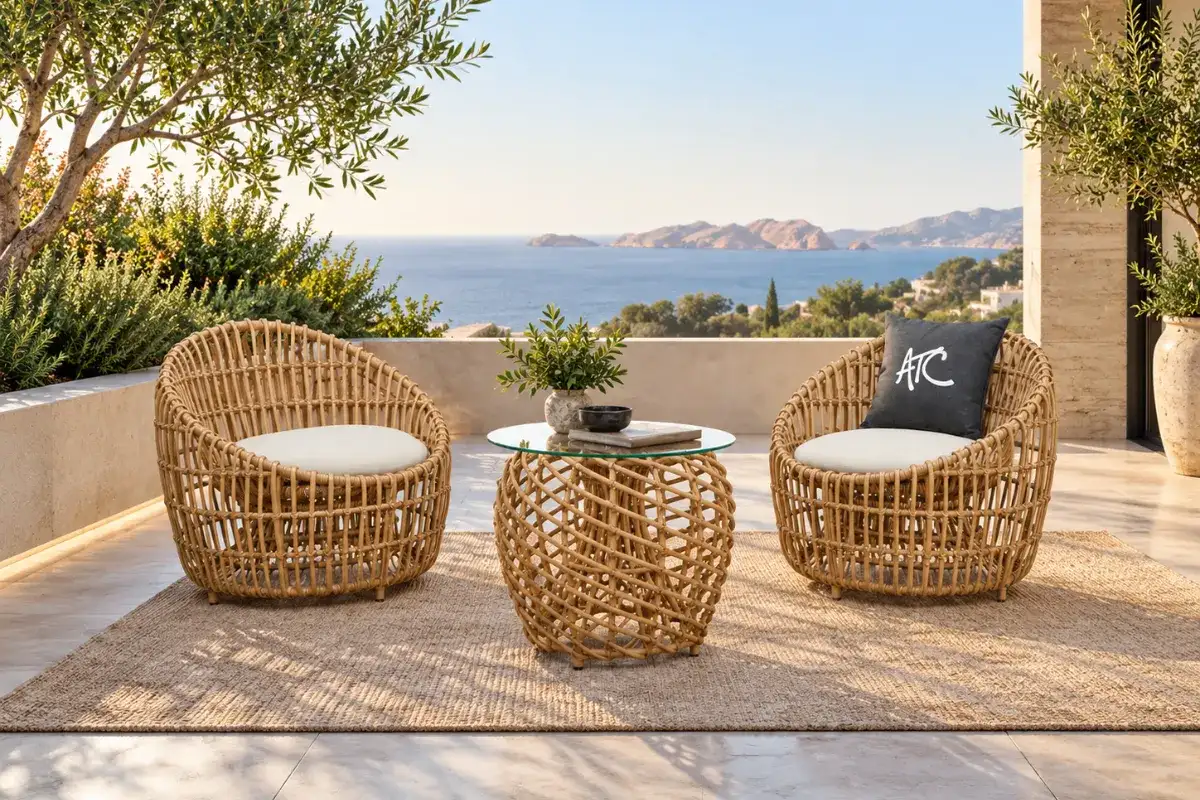
Well-balanced chair dimensions and compact table proportions create a comfortable seating arrangement for luxury resort terraces.
Standard dimensions may not work equally well for narrow balconies, large villa terraces, rooftop restaurants, or spaces with specific circulation requirements. A private villa may accommodate deeper lounge seating, while a compact balcony may require reduced seat depth and slimmer frames. Restaurant and rooftop layouts may need more controlled proportions to preserve capacity and service circulation.
Dimension changes should not be treated independently. Increasing seat depth, for example, may affect backrest angle, cushion proportions, frame construction, and the relationship between the chair and nearby tables.
Custom dimensions should therefore be developed as part of a complete product system rather than through isolated adjustments.
2.3 Custom Colors, Fabrics, and Finishes
High-end hospitality projects often require furniture to follow a defined visual palette. Frame finishes may coordinate with architectural metalwork, rope colors may reference flooring or stone, and fabrics may extend colors already used in guest rooms, restaurants, or public areas.
This allows existing products to develop a project-specific identity without requiring every piece to be redesigned from the beginning. Changing the combination of frame finish, rope, wicker, fabric, cushion structure, wood tone, or tabletop material can significantly alter the final appearance.
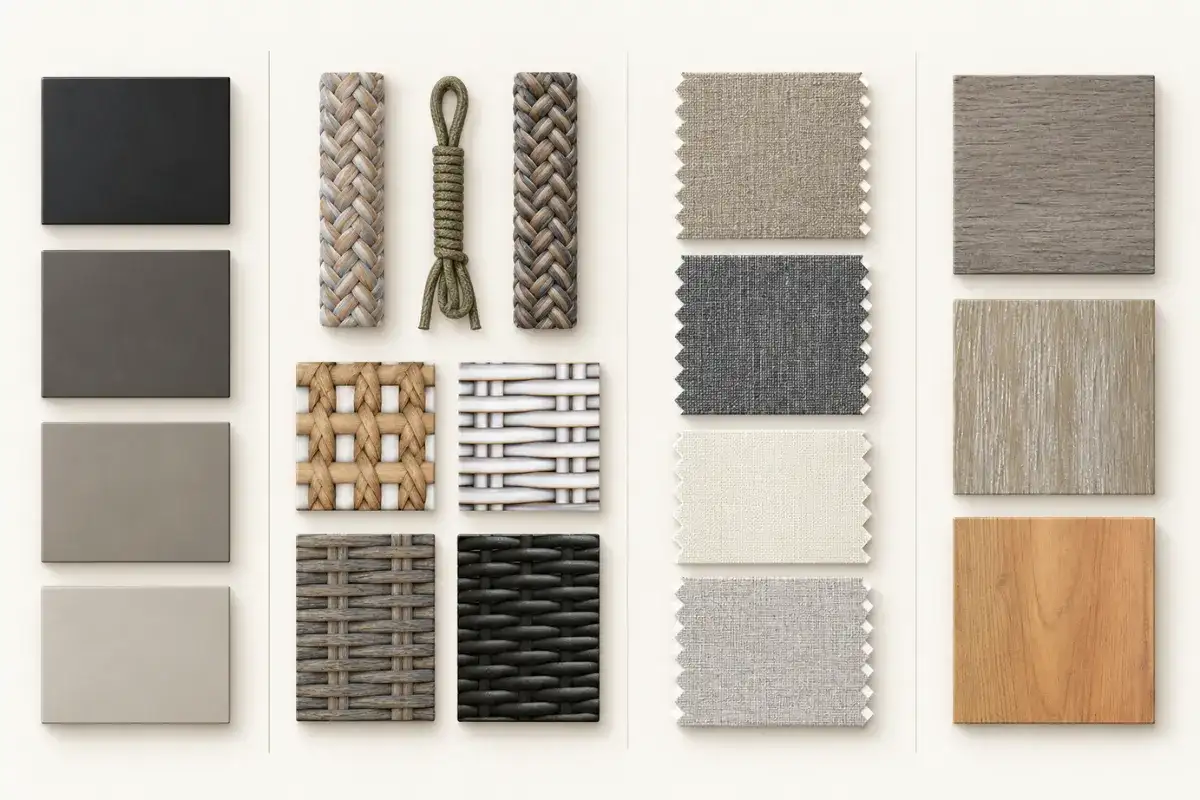
Coordinated frame colors, woven textures, fabrics, and wood finishes help create a consistent identity for luxury resorts.
The key requirement is documentation. Dimensions, material codes, finish references, fabric selections, cushion specifications, wood finishes, and other approved details should be clearly recorded before production begins.
3. From Design Concept to Approved Sample
Customized furniture should not move directly from a drawing or rendering into mass production. The sample stage allows the design concept to be tested against real proportions, materials, comfort, manufacturing conditions, and finishing quality.
3.1 Why Full-Scale Samples Matter
Technical drawings are useful for confirming measurements, but they cannot fully communicate how a product feels at full scale.
A sofa may look balanced on screen but feel excessively deep in use. A chair arm that appears slim in a rendering may feel visually heavy when produced. Material combinations can also appear different when viewed together under actual lighting.
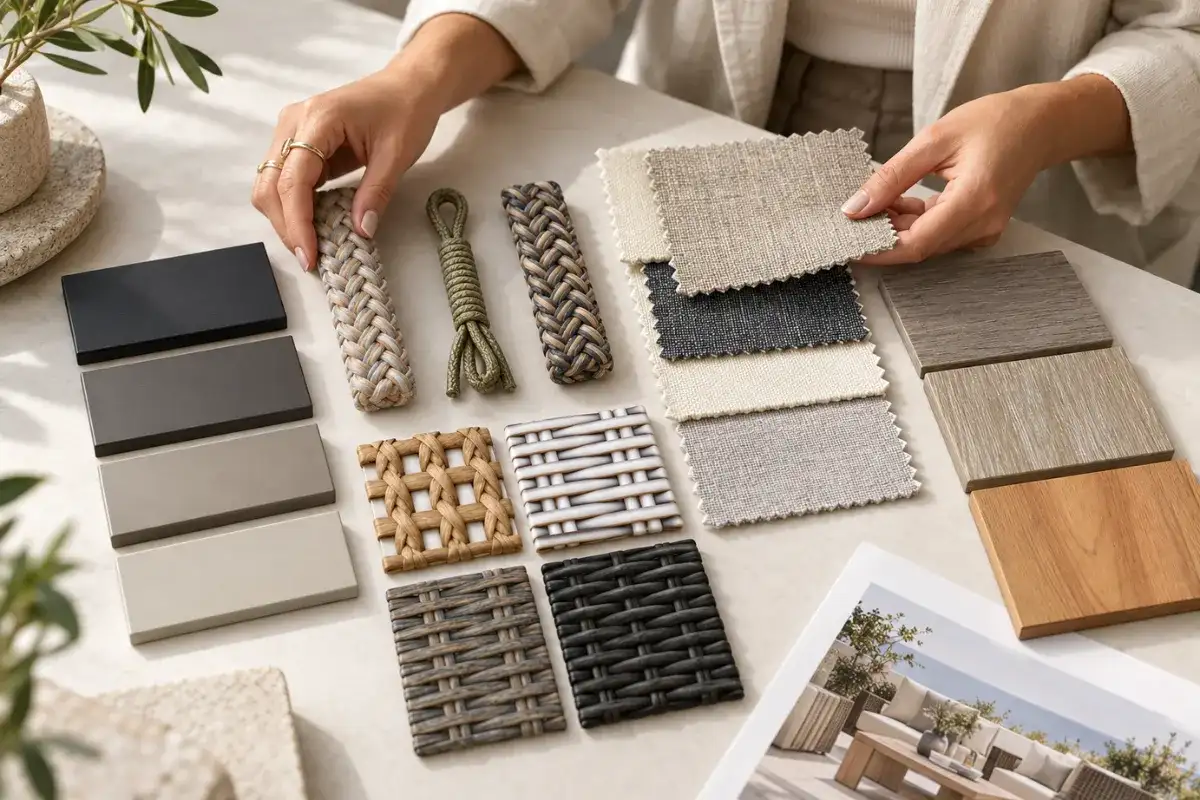
Physical material samples help buyers assess textures, colors, and finishes before approving full-scale furniture prototypes for production.
A physical sample allows buyers and designers to review:
- Overall proportions
- Seating comfort
- Frame construction and finishing
- Weaving quality
- Cushion shape and firmness
- Fabric and material combinations
- Seams and edge details
- Hardware and connection points
- Overall visual balance
This is particularly important for luxury outdoor lounge furniture for hotels, where comfort and proportion directly influence guest experience.
3.2 Refining the Product Before Production
The first sample does not need to become the final production version. Seat depth may need adjustment, cushion firmness may be changed, a frame curve may be refined, a rope color replaced, or a tabletop thickness reduced. These revisions are a normal part of developing customized products.
Each change should be documented before final approval. Once the product meets the agreed specification, the approved sample, technical drawing, and material references can form a common production standard.
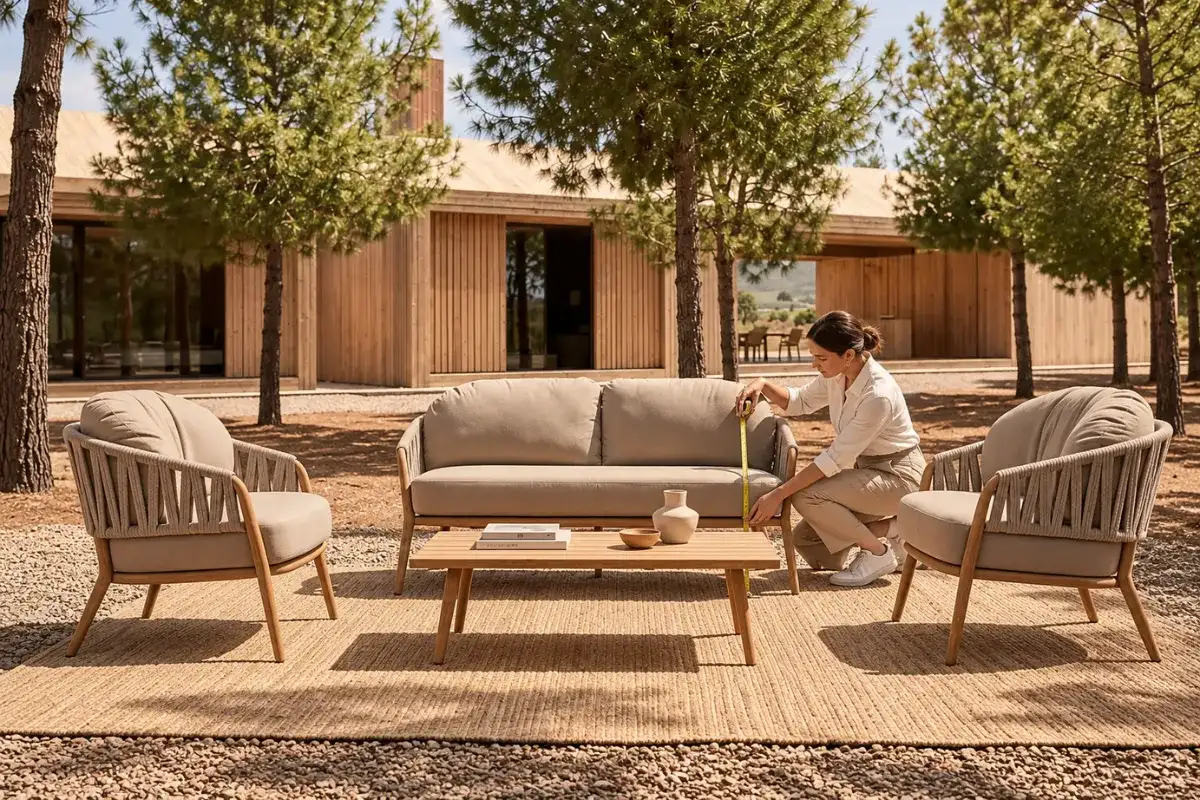
Checking actual furniture dimensions helps refine product proportions and ensure specifications are accurate before mass production.
This creates a clearer basis for manufacturing and quality inspection before larger quantities are produced.
3.3 Coordinating Specifications Across the Collection
A resort collection may contain very different product types, but shared finishes and material references should still be managed together.
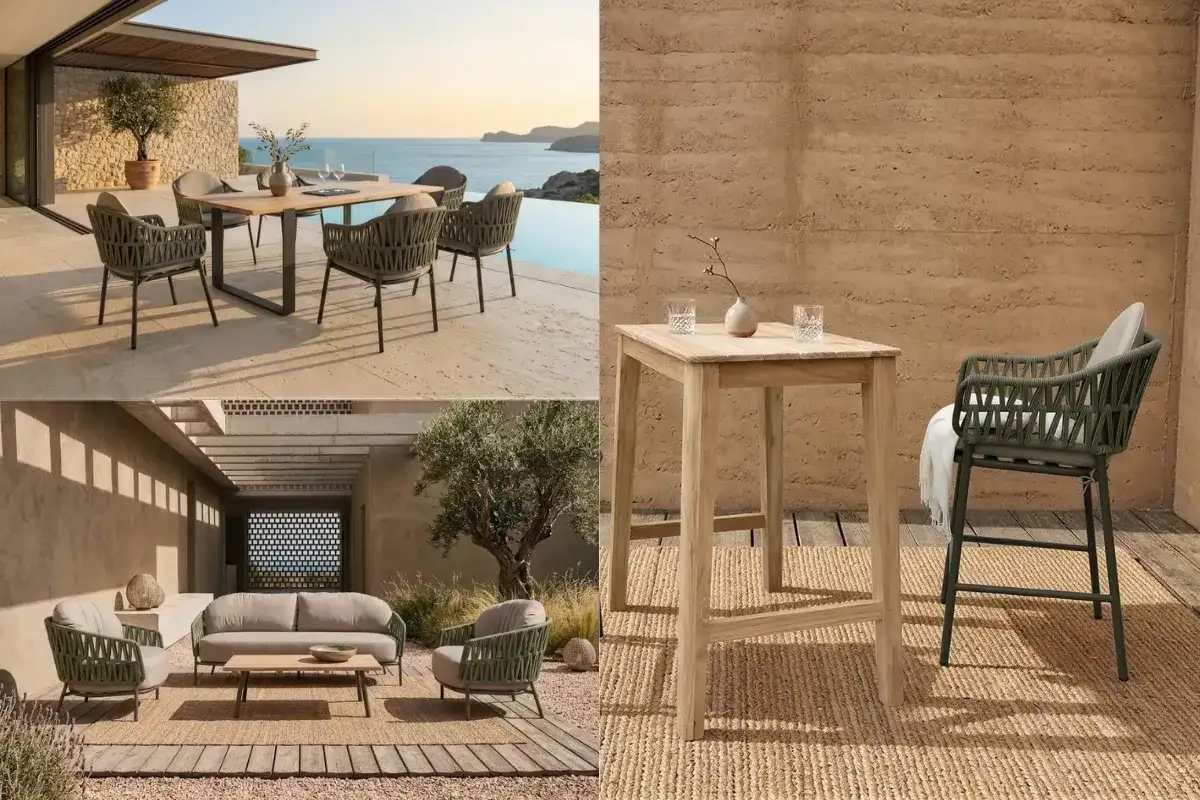
Consistent rope weaving, frame finishes, and neutral cushions create visual harmony across different resort furniture settings.
A dining chair, lounge sofa, sun lounger, and bar stool may use different structures while sharing the same frame finish, fabric family, rope color, or wood tone.
During sample development, these shared elements should be cross-checked rather than approved independently. This helps prevent small differences from becoming visually obvious after the collection is installed throughout the property.
4. Commercial Layouts for Luxury Resort Spaces
Furniture selection should be connected to how each area functions. Commercial layouts need to balance guest comfort, aesthetics, circulation, capacity, service access, and the surrounding architecture.
4.1 Poolside and Outdoor Lounge Areas
Pool areas are often among the most visible spaces within a resort. Their layout can therefore influence both guest experience and the overall visual impression of the property.
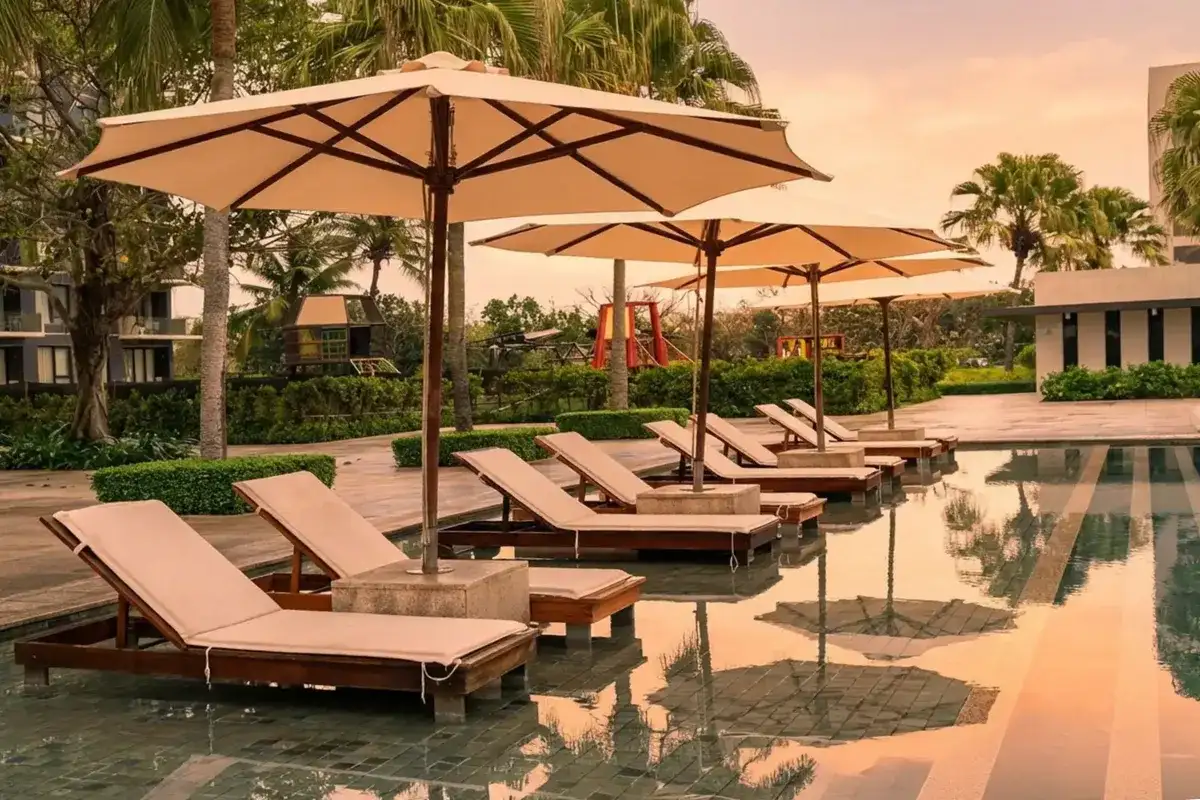
Comfortable sun loungers and shaded seating areas create a relaxing poolside environment while maintaining a refined resort atmosphere.
Instead of relying only on rows of identical loungers, high-end projects may combine loungers, side tables, daybeds, cabanas, and small lounge groups to create different levels of privacy and use.
Furniture orientation should also consider views, pool access, guest privacy, circulation, service routes, and spacing between groups. In beachfront settings, preserving sightlines can be just as important as the design of the furniture itself.
Generous proportions and thicker cushions can support a more relaxed experience, but the products still need to fit the available space and remain practical for staff to clean, move, and maintain.
4.2 Outdoor Dining and Bar Areas
Dining spaces require a different balance between comfort and operational efficiency.
Chairs need to remain comfortable during longer meals while fitting the intended table dimensions and restaurant layout. Tables should provide appropriate surface area, stable construction, and enough clearance for guests and service staff.
Oversized furniture can reduce capacity and restrict circulation. A well-proportioned dining chair with refined weaving, controlled detailing, and a carefully finished frame can communicate quality more effectively than a larger but less practical design.
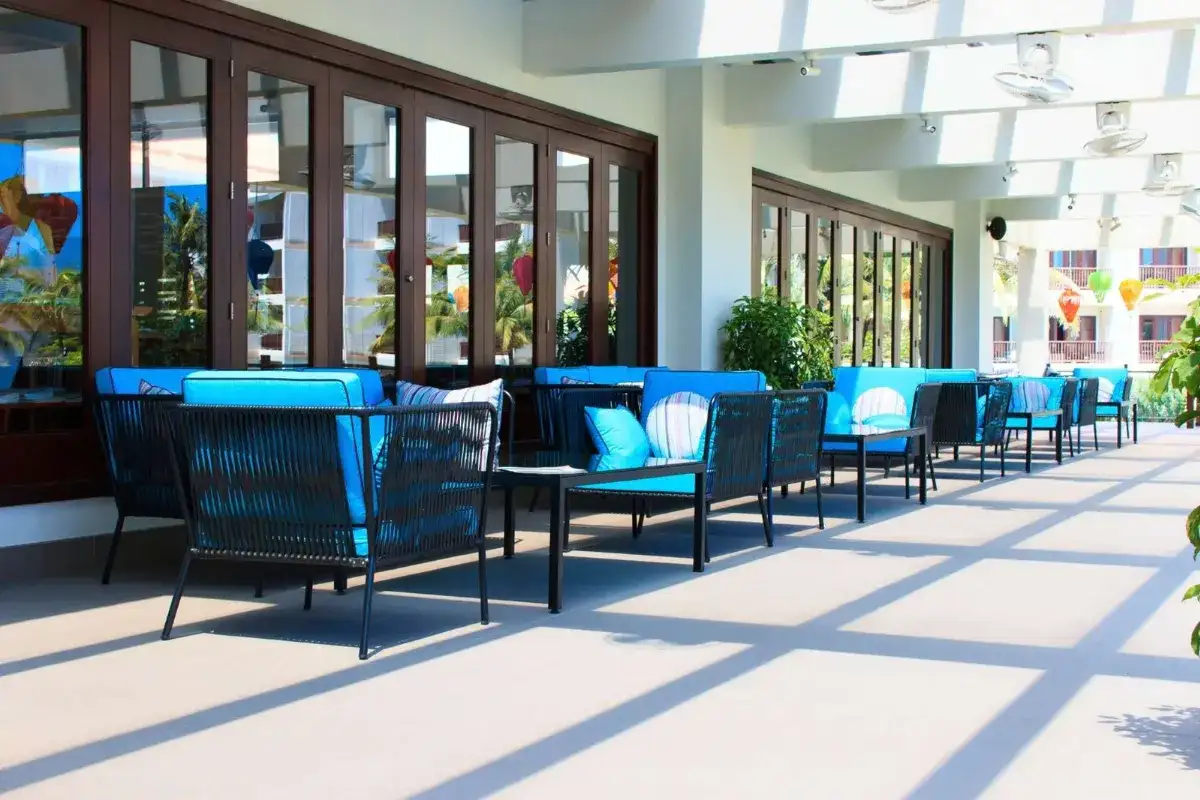
Well-spaced seating arrangements and comfortable cushions create an inviting outdoor dining area while supporting smooth guest circulation.
Bar furniture introduces additional dimensional relationships. Stool height, footrest position, table or counter height, seat spacing, and circulation around high tables all influence usability. Rooftop bars may also require careful consideration of open sightlines and exposure.
4.3 Villas, Balconies, and Rooftops
Private villas allow more flexibility because seating density is usually less important. Designers can create more residential arrangements using sofas, armchairs, loungers, coffee tables, and compact dining sets.
Balconies require more careful control of scale. Furniture should provide sufficient comfort without restricting circulation or blocking views.
Rooftop spaces require a combination of spatial and environmental planning. Product weight, exposure, wind, circulation, sightlines, and the relationship between lounge and dining zones should all be considered before quantities are finalized.
Resort Area |
Typical Furniture |
Main Design Priority |
Main Layout Consideration |
Poolside |
Loungers, daybeds, side tables |
Relaxation and visual spacing |
Views, circulation, water exposure |
Outdoor restaurant |
Dining tables and chairs |
Refined comfort |
Service flow and capacity |
Bar or rooftop |
Bar stools, high tables, lounge seating |
Atmosphere and views |
Sightlines, exposure, movement |
Private villa |
Sofas, loungers, dining sets |
Residential feel |
Privacy and proportion |
Balcony |
Coffee sets, compact lounge chairs |
Comfort in smaller spaces |
Footprint and circulation |
Zoning products by area helps buyers select furniture according to actual use while maintaining a coordinated overall design.
5. Balancing Premium Design with Commercial Performance
Furniture used in hospitality environments needs to perform beyond its initial appearance. Products may be moved regularly, cleaned frequently, exposed to sun and moisture, and used by many different guests.
Commercial performance should therefore be considered during product development rather than treated as a secondary concern.
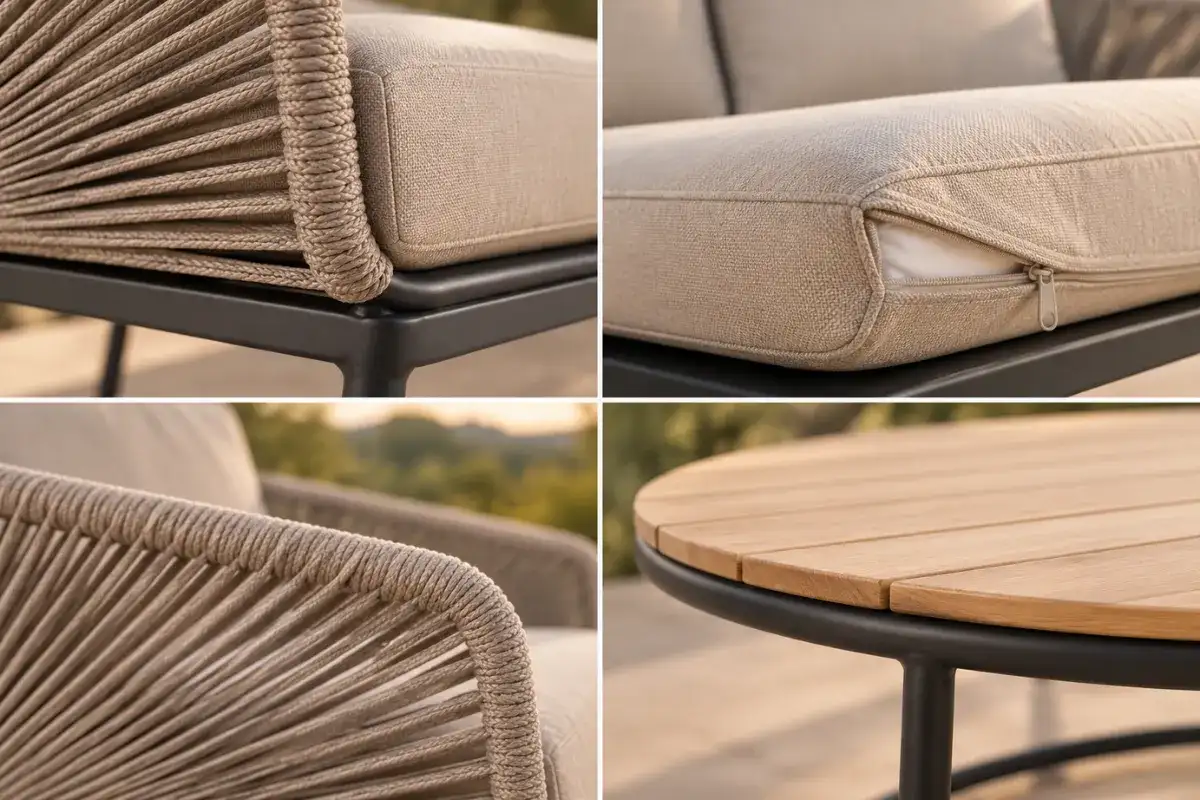
Durable frames, precise rope weaving, and removable cushions combine refined design with practical performance for hospitality spaces.
5.1 Designing Durability into the Product
Durability does not require furniture to look heavy or industrial.
Structural performance can be integrated into refined products through appropriate frame construction, reinforcement, joint design, hardware, finishing systems, and support points.
The intended use of the product should guide the specification. A dining chair in a busy outdoor restaurant may experience frequent movement throughout the day, while a lounge chair on a private terrace may remain in place for longer periods.
For high end commercial outdoor furniture, the most appropriate construction depends on where and how the product will actually be used.
5.2 Maintenance as a Design Consideration
Maintenance requirements should also influence product development.
Complex cushion arrangements, difficult-to-clean surfaces, inaccessible hardware, or highly specialized components can increase the workload for hotel staff.
Buyers and designers should consider how each product will be:
- Cleaned
- Moved
- Stored
- Dried after wet conditions
- Repaired
- Refreshed
- Supplied with replacement components
Removable cushion covers, accessible construction, replaceable components, and clearly specified hardware can simplify long-term maintenance without compromising the appearance of the collection.
5.3 Planning for Commercial-Scale Production
A successful sample demonstrates the intended design, but mass production introduces another challenge: repeating the approved standard across a larger quantity.
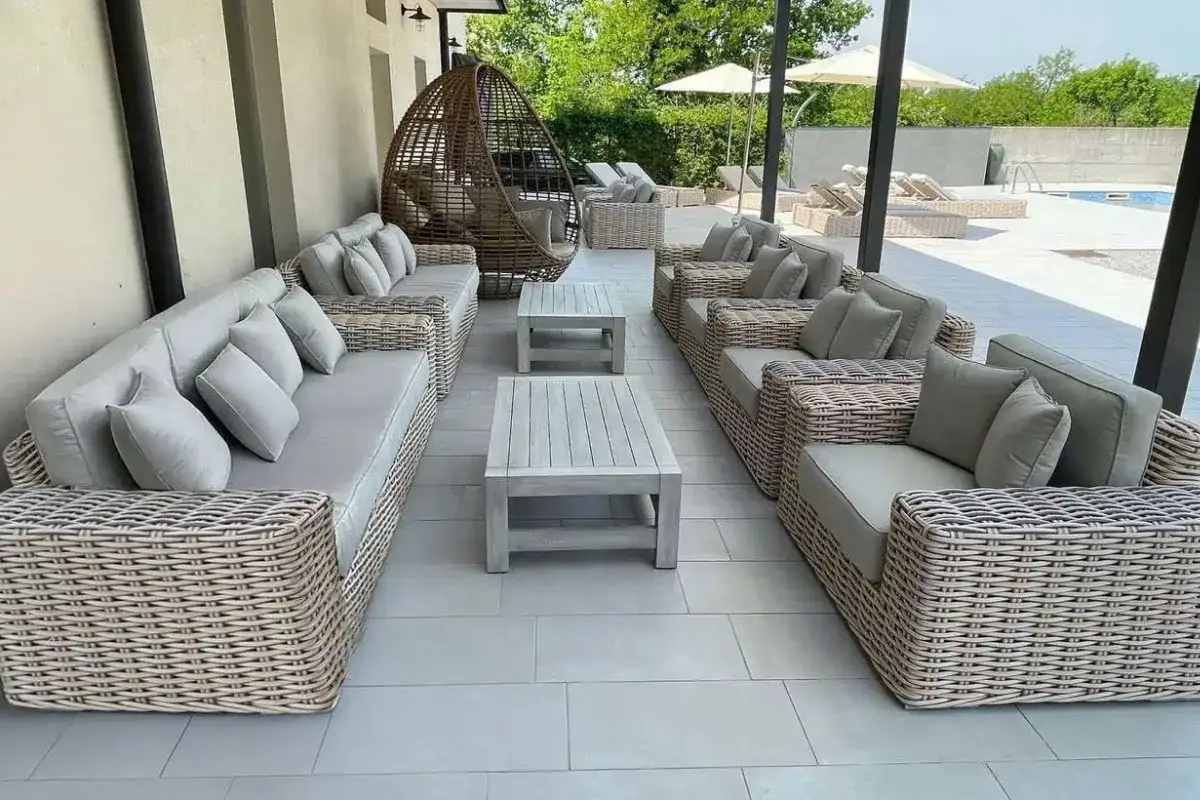
Consistent wicker patterns, cushion dimensions, and frame finishes help maintain product quality across large-scale resort furniture orders.
Buyers should establish clear references for the elements that matter most, such as:
- Overall dimensions and tolerances
- Frame finish
- Weaving tension and pattern
- Cushion dimensions
- Fabric reference
- Wood tone and finishing
- Hardware
- Assembly details
- Packaging requirements
Natural materials may show some variation, particularly wood. For this reason, acceptable visual variation should be understood during the approval process rather than discovered only during final inspection.
6. Choosing a Luxury Resort Outdoor Furniture Manufacturer
Selecting a manufacturer for a premium hospitality project requires more than comparing catalogs and unit prices.
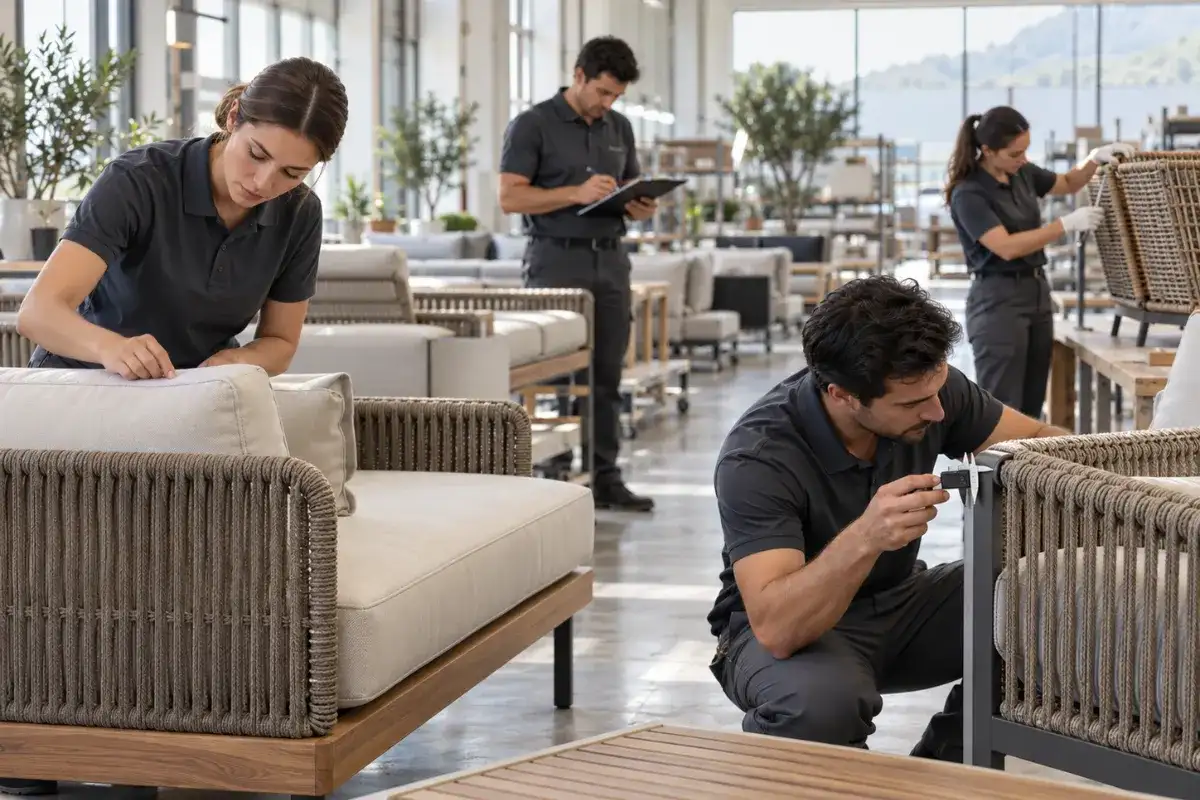
Careful quality inspections and skilled craftsmanship help manufacturers maintain consistent standards for luxury resort furniture projects.
The supplier needs to understand product development, customized specifications, material coordination, sample approval, production control, and the communication required across a commercial project.
6.1 Design and Development Capability
A supplier working on bespoke hospitality outdoor furniture should be able to work from drawings, reference images, technical specifications, or design concepts.
Buyers should evaluate how the manufacturer handles:
- Dimension revisions
- Material combinations
- Technical drawings
- Prototype or sample development
- Feedback after sample review
- Changes before mass production
The ability to interpret and refine a design can be more relevant to a customized project than the size of the supplier's existing catalog.
6.2 Material and Finish Control
Premium collections often rely on subtle relationships between frame finishes, fabrics, rope, wicker, wood, and cushions.
If the same finish or fabric appears across several product categories, the manufacturer should work from clear references so that different products remain visually coordinated.
Buyers can request that approved samples, swatches, material codes, or finish references are retained as production benchmarks, especially when a project includes several product types or production phases.
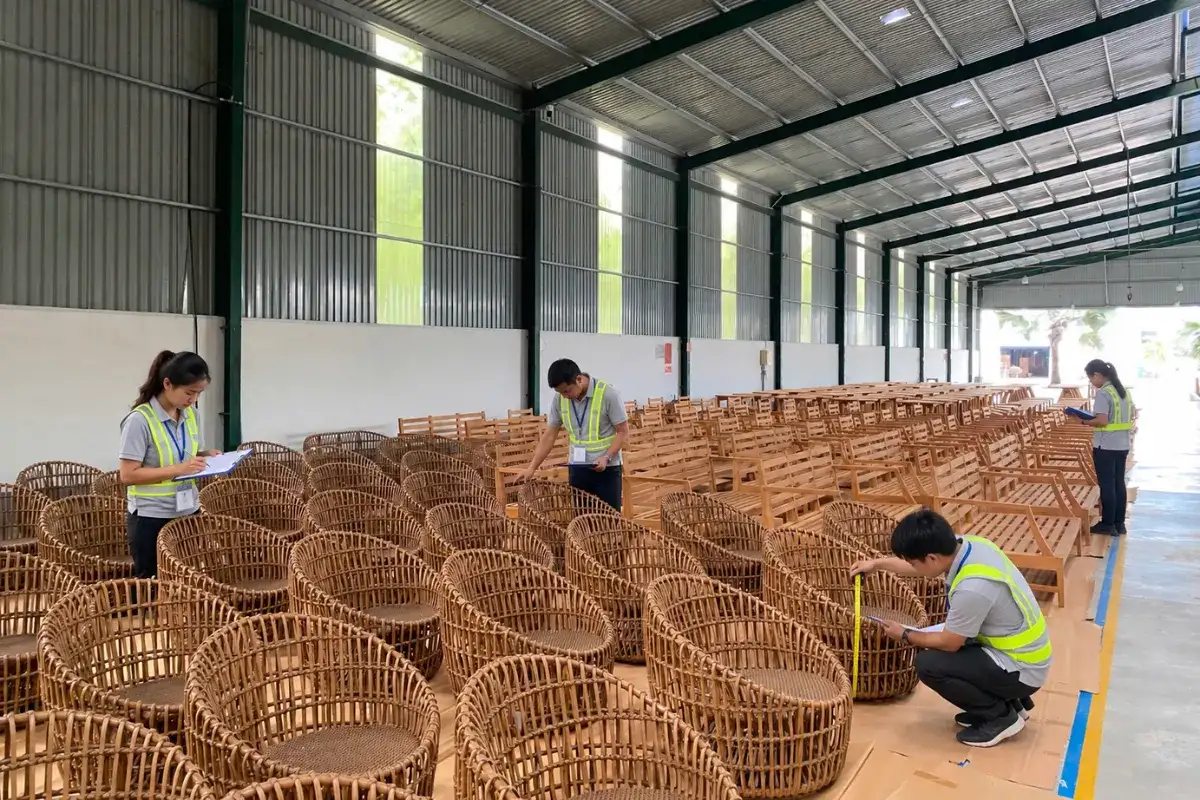
Regular inspections of weaving, dimensions, and finishes help maintain consistent material standards across large furniture production batches.
6.3 Production and Quality Control
Production capability should be evaluated against the actual construction of the furniture being ordered.
For larger projects, buyers should understand how the manufacturer controls key stages relevant to the collection, such as frame production, finishing, weaving, woodworking, cushion work, assembly, and packing.
QC criteria can be established before production and may include:
QC Area |
Items to Review |
Dimensions |
Overall size, seat dimensions, table height, tolerances |
Structure |
Frame alignment, joints, welding, reinforcement |
Finish |
Coating consistency, wood finish, edge treatment |
Weaving |
Pattern, tension, spacing, attachment points |
Cushions |
Dimensions, firmness, fabric, stitching, fit |
Appearance |
Color coordination and consistency between units |
Packaging |
Protection, labeling, component security |
Defining these checkpoints before production gives both buyer and manufacturer a clearer reference for the finished order.
6.4 Communication and Project Coordination
Hospitality projects often involve designers, purchasing teams, developers, contractors, and manufacturers. Changes can occur during sampling, material approval, or site coordination.
A supplier should therefore be able to document revisions and clearly identify which specifications are approved for production.
Before placing a commercial order, buyers may find it useful to prepare a project brief or RFQ containing:
- Product references or drawings
- Required quantities
- Installation areas
- Dimensions
- Material preferences
- Frame finish
- Rope or wicker references
- Fabric and cushion specifications
- Wood finish
- Required samples
- Target delivery schedule
- Packing requirements
- Destination
The clearer the project information, the easier it becomes to compare proposals and reduce misunderstanding during development.
Supplier Criteria |
What Buyers Should Evaluate |
Product development |
Ability to work from drawings, references, and specifications |
Sample quality |
Comfort, proportions, materials, workmanship, finishing |
Material control |
Management of fabrics, frame finishes, rope, wicker, and wood |
Production consistency |
Ability to reproduce approved standards at commercial scale |
Customization |
Flexibility in dimensions, colors, materials, and details |
Quality control |
Defined inspection criteria during and before final production |
Communication |
Clear revision tracking and project coordination |
Hospitality experience |
Understanding of commercial project requirements |
For buyers sourcing luxury resort outdoor furniture, unit price should therefore be considered together with development capability, specification control, sample quality, manufacturing consistency, QC, and project coordination.
7. Frequently Asked Questions
7.1 What Is Luxury Resort Outdoor Furniture?
Luxury resort outdoor furniture is developed for high-end hospitality environments with greater emphasis on design coordination, comfort, refined materials, custom specifications, detailing, and commercial performance.
7.2 Which Materials Are Commonly Used for Luxury Resort Furniture?
Powder-coated aluminum, teak, synthetic wicker, outdoor rope, performance fabrics, and different tabletop materials are commonly used. Many premium collections combine several materials rather than relying on a single surface.
7.3 Can Luxury Hotel Outdoor Furniture Be Customized?
Yes. Depending on the manufacturer and project requirements, customization may include dimensions, frame finishes, weaving colors, rope, fabrics, cushion specifications, wood details, tabletops, and other design elements.
7.4 Why Is Sample Approval Important?
A full-scale sample allows buyers to evaluate comfort, proportions, materials, finishes, craftsmanship, and construction before mass production. Once approved, it can also provide a practical reference for production and quality control.
7.5 What Should Buyers Provide When Requesting a Custom Resort Furniture Quotation?
A useful RFQ should include product references or drawings, quantities, required dimensions, materials, colors or finishes, fabric and cushion requirements, customization details, project location, destination, and expected delivery schedule.
Providing clear specifications allows the manufacturer to prepare a more accurate proposal and identify any areas that require further development or sample approval.