Outdoor Furniture Quality Control Checklist for Outdoor Furniture Buyers

Sourcing high quality outdoor furniture from overseas can create strong opportunities for importers, brand owners, hospitality buyers, and project contractors. However, bulk orders also involve risks related to material consistency, production quality, packaging, shipping damage, documentation, and delivery schedules.
For B2B buyers, quality control should begin before mass production rather than only at the final inspection stage. A structured outdoor furniture quality control checklist helps buyers compare suppliers, confirm technical requirements, review samples, monitor production, and reduce unexpected issues before shipment.
This guide focuses on the key checkpoints international buyers should review when sourcing outdoor commercial furniture, including factory capability, materials, structural construction, surface finishing, cushion specifications, packaging, inspection procedures, and procurement documentation.
Quick Quality Control Checklist
☐ Factory capability and production capacity |
☐ Golden Sample approval |
☐ Material specifications and traceability |
☐ In-process and final quality inspection |
☐ OEM/ODM and customization capability |
☐ Packaging and labeling requirements |
☐ Frame construction and structural stability |
☐ Export documentation and compliance |
☐ Weaving, rope, and surface finishing quality |
☐ MOQ and production lead time |
☐ Cushion, fabric, and foam specifications |
☐ Warranty and defect handling |
☐ Hardware and component quality |
☐ Pre-shipment inspection |
☐ Approved product specifications |
☐ Written approval of revisions and changes |
1. Core Evaluation Criteria for Overseas B2B Buyers
When comparing manufacturers for high-volume orders, B2B buyers should evaluate total commercial value rather than focusing on FOB price alone. A lower quotation may not provide the same level of material quality, product engineering, packaging, inspection support, or production reliability.
For high quality outdoor furniture, supplier evaluation should consider both product performance and the manufacturer’s ability to support repeat orders, customization, logistics, and quality control.
1.1 Key Sourcing Comparison Matrix for International Importers
Key B2B Evaluation Criteria |
Operational Impact on Buyer’s Business |
What Buyers Should Verify |
OEM/ODM & Private Labeling |
Supports customized collections, branding, packaging, and product differentiation |
Prototype capability, drawings, custom components, branding options, and confidentiality procedures |
CBM & Container Optimization |
Helps control freight cost per unit and improve container efficiency |
Stackability, knock-down construction, carton dimensions, and container loading plans |
Factory Compliance & Audits |
Helps buyers evaluate management systems, responsible sourcing, and market requirements |
Relevant audit reports, quality systems, material documentation, and certifications where applicable |
Logistics & Defect Control |
Reduces product damage, claims, and replacement costs |
Packaging standards, inspection procedures, defect limits, spare parts, and loading checks |
MOQ & Lead Time Stability |
Supports inventory planning and project scheduling |
MOQ structure, seasonal capacity, production lead time, and flexibility for trial orders |
The exact requirements will vary by buyer, destination market, and product category. For example, hotel outdoor furniture may require stronger durability and project consistency, while retail collections may place greater emphasis on packaging efficiency, branding, and repeatability across multiple shipments.
Buyers sourcing outdoor contract furniture should therefore compare suppliers using the same specifications, inspection expectations, and commercial conditions. This makes supplier evaluation more consistent and prevents a low initial quotation from hiding differences in materials, construction, packaging, or service scope.
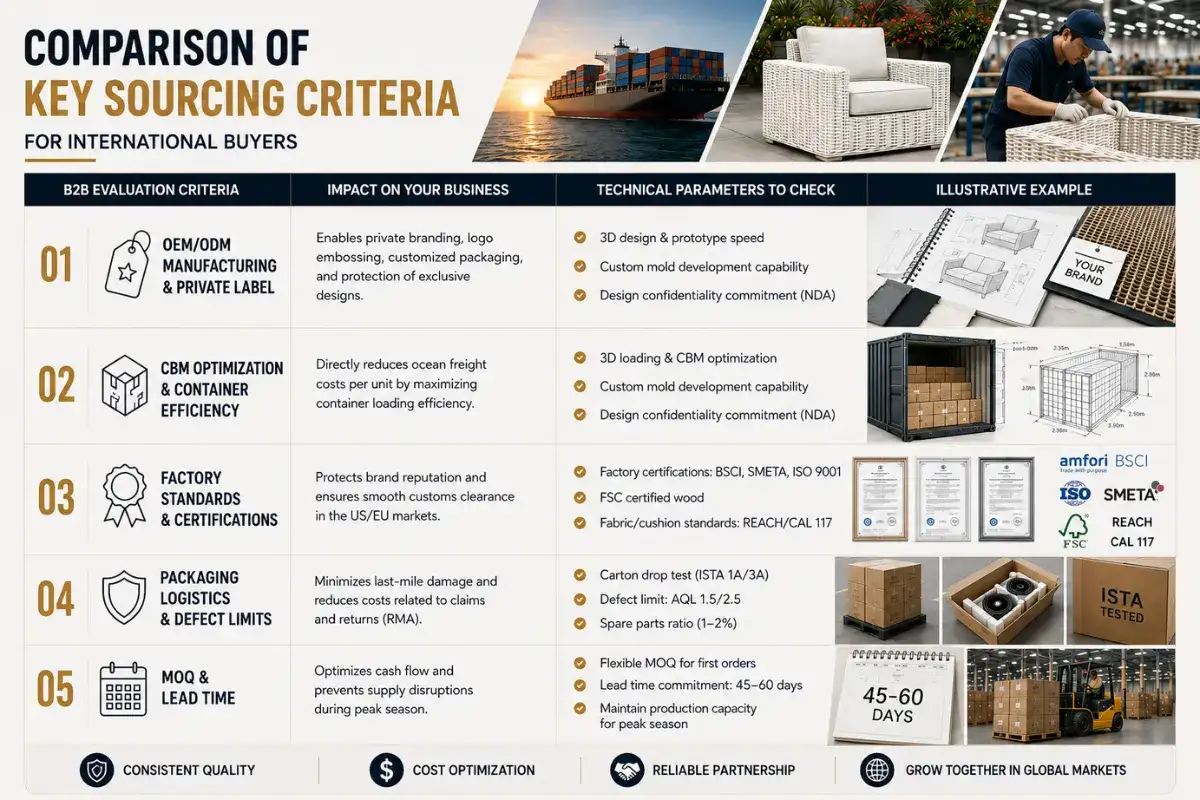
Key B2B evaluation criteria for selecting reliable outdoor furniture manufacturers and managing quality control (Source: ATC Craft.com)
2. Factory and Export Capability Checklist
Before approving samples or placing large orders, buyers should verify whether the supplier has suitable production capability, material control, quality systems, and export experience for outdoor contract furniture.
2.1 Production Infrastructure, Material Sourcing, and Export Compliance
- Production infrastructure: Check equipment, production areas, and whether key processes such as welding, powder coating, weaving, assembly, and packaging are completed in-house or subcontracted.
- Material sourcing: Confirm specifications for aluminum, wood, synthetic wicker, rope, fabrics, foam, hardware, and coatings.
- Quality control: Review incoming material checks, in-process inspections, final inspection procedures, and defect handling.
- Factory compliance: Verify relevant audits, certifications, or management systems when required by the buyer or destination market.
- Export documents: Confirm experience with invoices, packing lists, bills of lading, certificates of origin, and other required shipping documents.
For outdoor commercial furniture, production capability and export capability should be evaluated together. Consistent materials, documentation, packaging, and quality control are especially important for repeat orders and large commercial projects.
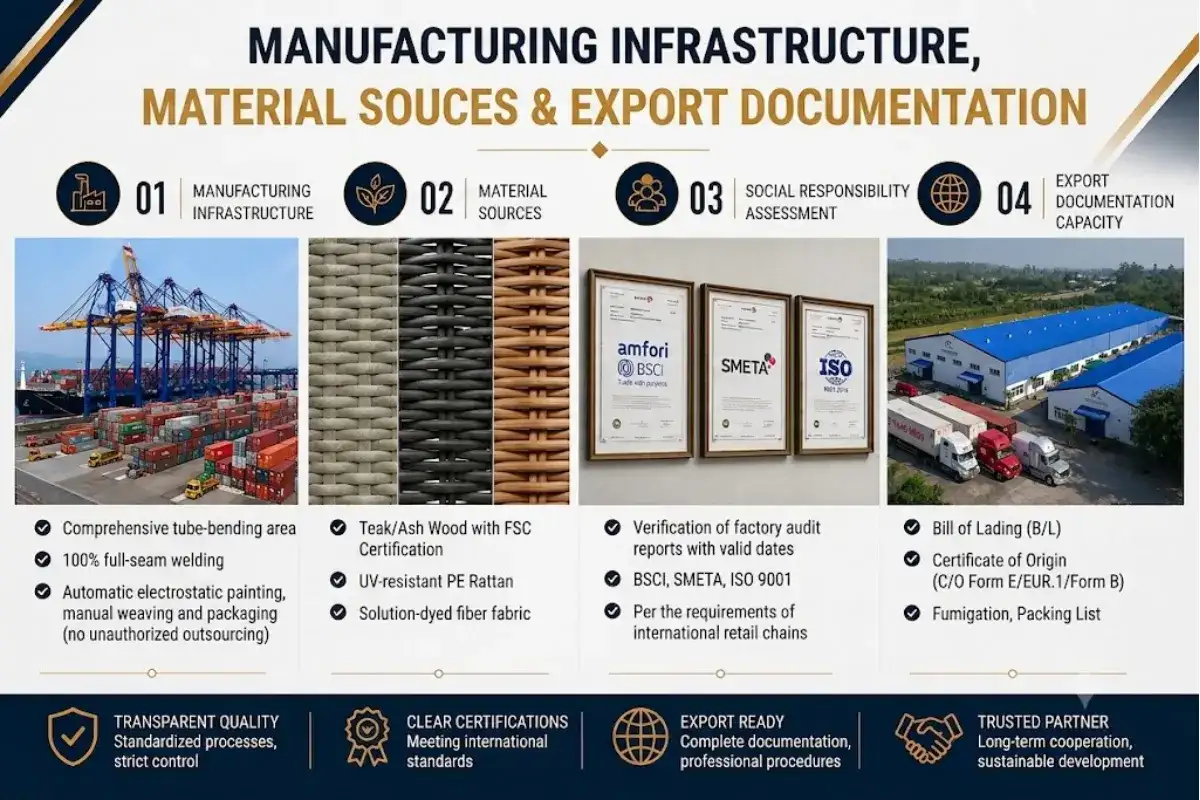
Key evaluation criteria for manufacturing infrastructure, material certifications, and export compliance for contract outdoor furniture. (Source: ATC Craft.com)
3. Product Quality & OEM Engineering Checkpoints
Product samples should be evaluated for both appearance and structural performance. Buyers should define clear specifications before mass production and use the approved sample as the reference during later inspections.
3.1 Structural Integrity, Surface Finishing, Cushion Specs, and Weather Resistance
- Frame construction: Check dimensions, welding, reinforcement points, stability, and tubing specifications.
- Weaving and rope: Review tension, spacing, edge finishing, attachment points, and material consistency.
- Surface finishing: Inspect powder coating, wood sanding, joints, treatment, and color consistency.
- Cushions and upholstery: Confirm fabric, foam, stitching, zippers, drainage, and outdoor-use specifications.
- Hardware: Check screws, bolts, glides, connectors, and spare parts requirements.
- Durability testing: Review relevant reports for load performance, corrosion resistance, structural stability, or other project requirements when applicable.
For commercial outdoor furniture chairs, hotel outdoor furniture, and other high-use products, consistency across the full production batch is just as important as the quality of the approved sample.

Essential technical specifications and durability test standards for contract outdoor furniture. (Source: ATC Craft.com)
4. Sample Sign-Off and Pre-Shipment Inspection (PSI)
Buyers should avoid starting mass production based only on renderings or unapproved prototypes. A clear approval and inspection process helps ensure the final order matches the agreed specifications.
4.1 Golden Sample Approval
Before mass production, approve a fully finished Golden Sample that reflects the final dimensions, materials, colors, branding, hardware, and construction details. This sample should be used as the main reference for production and later quality inspections.

Official Golden Sample approval for private label outdoor furniture before mass production. (Source: ATC Craft.com)
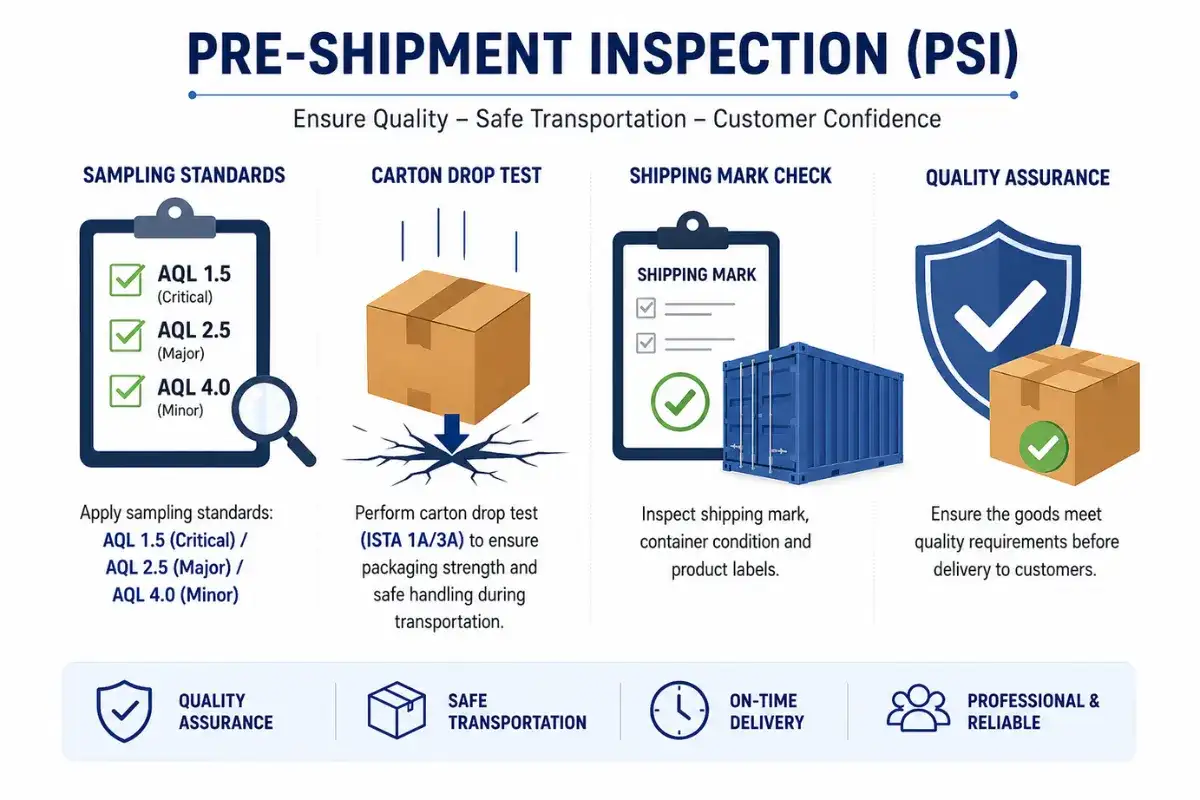
4.2 Pre-Shipment Inspection (PSI)
A pre-shipment inspection should be carried out before the order is released for shipping. Buyers may use their own QC team or an independent inspection company depending on project requirements.
Key checks may include:
- Product quantity and overall condition.
- Dimensions, materials, colors, and finishing.
- Packaging, labels, shipping marks, and barcodes.
- Functional checks and basic assembly.
- Carton condition and protective packaging.
- Sampling based on an agreed inspection standard where applicable.
For outdoor contract furniture, combining Golden Sample approval with pre-shipment inspection helps reduce the risk of specification errors, packaging issues, and inconsistent quality across bulk orders.
Official Golden Sample approval for private label outdoor furniture before mass production. (Source: ATC Craft.com)
5. Red Flags International Buyers Should Avoid
During supplier evaluation, buyers should watch for warning signs that may indicate higher sourcing risk. Common red flags include:
- Unusually low FOB prices without a clear explanation of materials, construction, or specifications.
- Reluctance to provide material information, test reports, or relevant documentation.
- Vague production timelines or unclear information about peak-season capacity.
- Inconsistent communication or frequent changes to previously confirmed specifications.
- Refusal to allow quality inspections before shipment or before final payment.
- Samples that do not match the supplier’s stated production standards.
For buyers sourcing outdoor commercial furniture, these issues can lead to quality differences, delays, unexpected costs, or disputes during bulk production. Supplier transparency and consistent communication should therefore be considered alongside pricing.
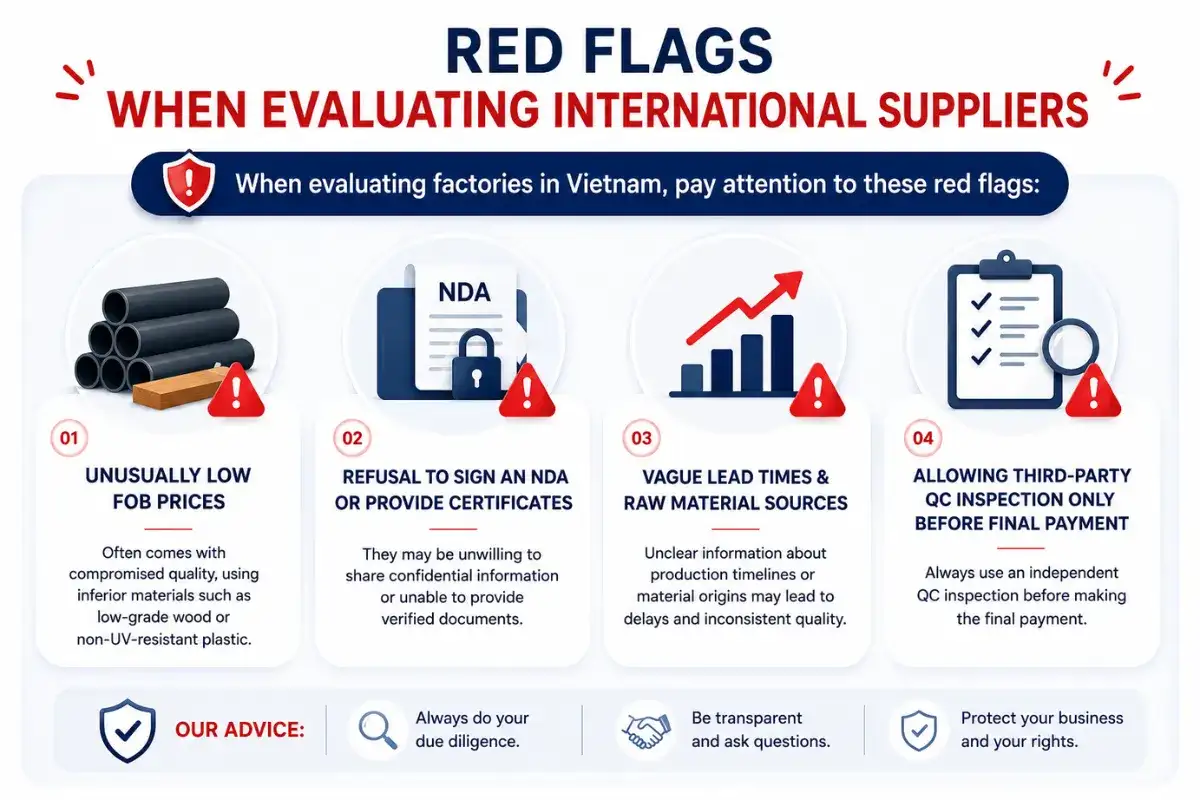
Red flags and potential risks to watch out for during outdoor furniture factory audits in Vietnam. (Source: ATC Craft.com)
6. How to Structure Your Procurement Contract
A clear procurement contract helps buyers and suppliers work from the same technical and commercial requirements. When you select the right outdoor furniture supplier, key terms should be confirmed in writing before production begins.
Important items to include are:
- Technical specifications: Materials, dimensions, colors, finishes, weave patterns, hardware, cushion details, and packaging requirements.
- Quality standards: Approved samples, inspection procedures, acceptable defect levels, and corrective actions.
- Production and delivery terms: Lead time, shipment schedule, packaging, labeling, and agreed Incoterms.
- Defect and claim procedures: Replacement parts, credits, rework responsibilities, and claim timelines.
- Intellectual property: Confidentiality and restrictions on using or selling proprietary designs where applicable.
For outdoor furniture contract orders, attaching approved drawings, material specifications, and sample references to the purchase order helps reduce misunderstandings during production.
Essential terms and clauses to include in B2B outdoor furniture procurement contracts for secure cross-border trade. (Source: ATC Craft.com)
7. Frequently Asked Questions
7.1 What Should Buyers Check Before Approving Outdoor Furniture for Mass Production?
Buyers should confirm dimensions, materials, frame construction, surface finishing, weaving or rope quality, cushion specifications, hardware, branding, and packaging. The approved sample should be used as the main reference for mass production and later inspections.
7.2 Why Is a Pre-Shipment Inspection Important?
A pre-shipment inspection helps verify product quality, quantity, packaging, labels, and shipping marks before goods are released. It can also identify specification errors or visible defects before the order leaves the factory.
7.3 How Can Buyers Evaluate Outdoor Furniture Quality More Consistently?
Use clear technical specifications, approved samples, written quality standards, and agreed inspection procedures. Buyers should also review factory capability, material control, and quality management rather than relying only on product photos or price.
7.4 Should Buyers Use Third-Party Quality Inspection Services?
They can be useful when buyers do not have an in-house QC team or need independent verification before shipment. The inspection scope should be agreed in advance based on the product, order size, and project requirements.
7.5 What Are the Most Important Quality Risks in Outdoor Furniture Sourcing?
Common risks include inconsistent materials, weak construction, poor finishing, packaging damage, specification errors, and production delays. A structured quality control process helps reduce these risks throughout sourcing and production.