Furniture Factory Audit Checklist for Outdoor Furniture Buyers

Choosing the right outdoor furniture manufacturer involves more than comparing product catalogs or pricing. Before placing a bulk order, buyers need to evaluate whether a supplier has the manufacturing capability, quality management systems, and export experience required to deliver consistent results. This furniture factory audit checklist provides a practical framework for assessing potential suppliers, helping buyers identify risks early, compare manufacturers objectively, and make more informed sourcing decisions before production begins.
Quick Furniture Factory Audit Checklist
|
Category |
Status |
|
Production capacity verified |
☐ |
|
Lead time confirmed |
☐ |
|
Material sourcing reviewed |
☐ |
|
FSC CoC certification checked (if applicable) |
☐ |
|
OEM/ODM capability reviewed |
☐ |
|
Export documents verified |
☐ |
|
Weld quality inspected |
☐ |
|
Surface finishing inspected |
☐ |
|
Cushion specifications confirmed |
☐ |
|
UV-resistant and corrosion-resistance reports reviewed |
☐ |
|
Production sample approved |
☐ |
|
Pre-shipment inspection scheduled |
☐ |
1. Why Supplier Evaluation Matters Before Bulk Orders
An attractive product catalog or competitive pricing can help a supplier stand out during the early stages of supplier selection. However, neither provides enough information about how a factory actually operates once production begins. For buyers placing bulk orders, the real challenge is not finding a manufacturer that can produce an impressive sample; it is finding one that can consistently deliver products that meet the same quality standards across every shipment.
This is especially important when sourcing high quality outdoor furniture. Products designed for outdoor use must withstand continuous exposure to sunlight, moisture, temperature fluctuations, and everyday wear. Their long-term performance depends on more than design or appearance. Material selection, manufacturing standards, quality control procedures, and process consistency all play equally important roles in ensuring product reliability.
Using a furniture factory audit checklist also creates a standardized evaluation process. Instead of relying on assumptions or personal impressions during a factory visit, buyers can assess every supplier against the same criteria. This also supports the process of choosing a reliable furniture supplier, making it easier to compare manufacturers objectively, identify potential risks early, and select a long-term manufacturing partner.
2. Factory and Export Capability Checklist
Before evaluating product quality, buyers should first determine whether a factory has the manufacturing capability to support large-scale production. Even a well-made sample cannot compensate for weak production planning, inconsistent material management, or limited export experience. Assessing these areas early helps buyers determine whether the manufacturer has the production infrastructure needed to deliver consistent results across multiple orders.
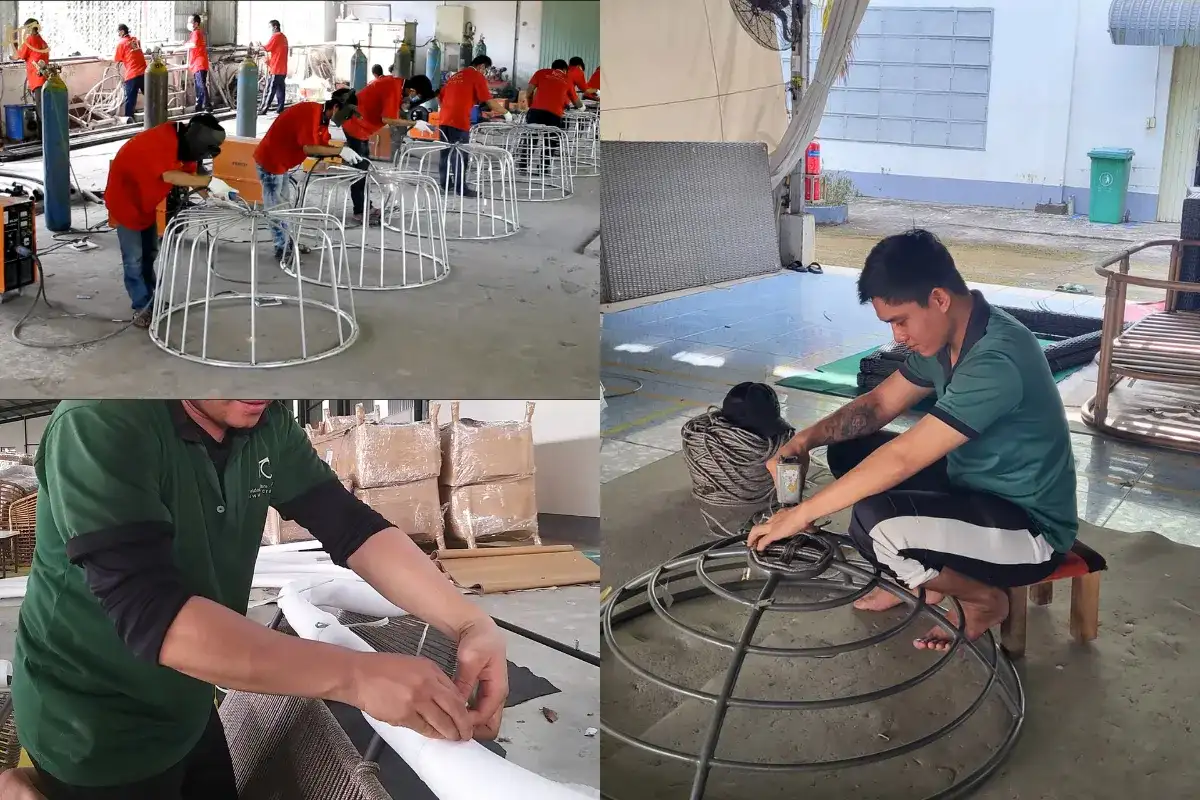
A capable factory combines skilled craftsmanship, efficient production systems, and consistent quality control.
When choosing the right outdoor furniture supplier, manufacturing capability is often a stronger indicator of long-term reliability than pricing alone.
2.1 Production Capacity, Material Sourcing, Product Categories, and Export Documents
Use the following checklist to evaluate a manufacturer's production capability, material sourcing, and export readiness.
Production Capacity
- Verify monthly production capacity and average lead times.
- Confirm whether dedicated production lines are available for outdoor furniture.
- Review OEM, ODM, and private-label manufacturing capabilities.
- Review how production schedules are managed during peak seasons.

Evaluating production capacity helps buyers confirm whether a factory can support consistent large-scale orders.
Material Sourcing
- Confirm that aluminum, teak, synthetic wicker, outdoor fabrics, and fastening hardware are sourced from qualified suppliers.
- Review incoming material inspection procedures before production begins.
- Check whether raw materials can be traced throughout the manufacturing process.
- For wood products, verify FSC Chain of Custody (CoC) certification, where applicable.
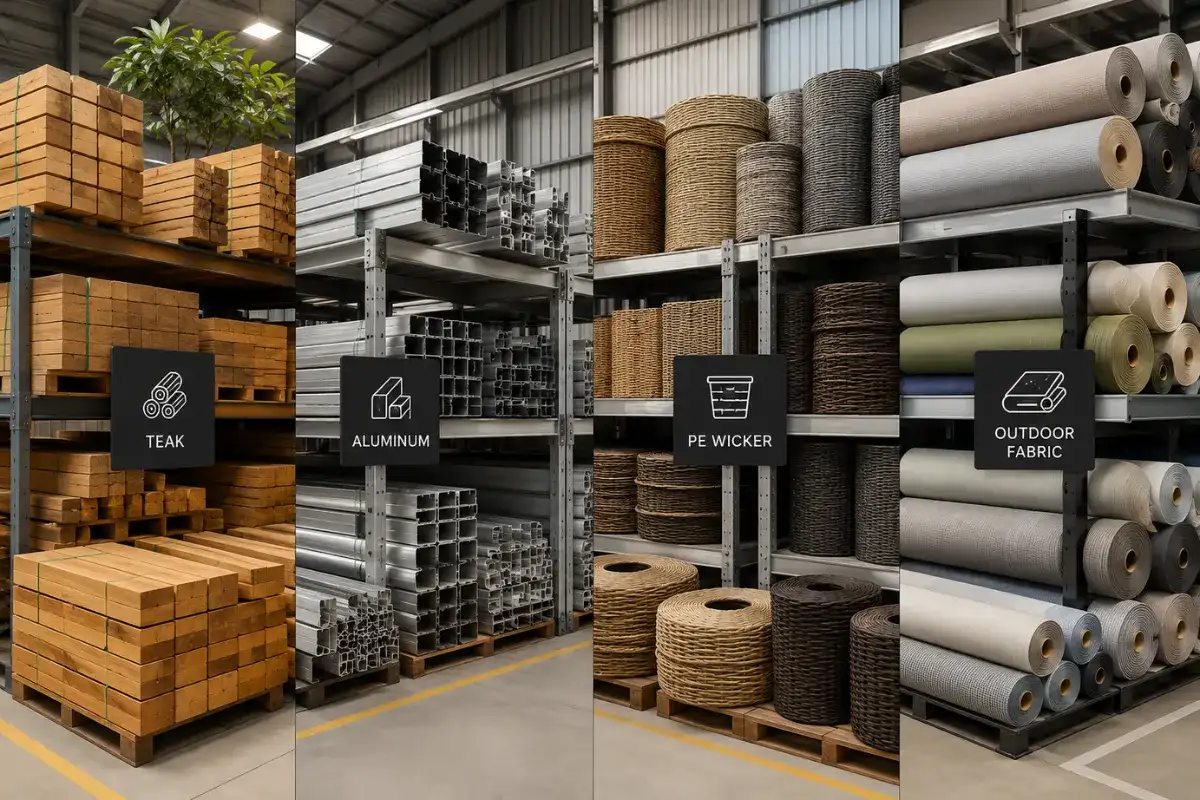
Using qualified materials is the foundation for producing durable, reliable, and export-ready outdoor furniture.
Product Categories
- Review the factory's experience manufacturing dining sets, lounge furniture, sofas, and sun loungers.
- Assess expertise in producing quality wicker furniture for residential and commercial applications.
- Request examples of completed export projects for wholesalers, retailers, or hospitality customers.
Export Documents
- Verify valid business registration and export licenses.
- Confirm the availability of standard export documents, including commercial invoices, packing lists, certificates of origin, and other destination-specific documentation where required.
- Review the manufacturer's export experience in your target markets.
- Confirm that the factory understands destination market compliance requirements.
3. Product Quality Checkpoints
A factory's manufacturing capability indicates whether it can produce at scale, but product quality demonstrates how effectively those processes are controlled. During a factory audit, buyers should look beyond the appearance of finished furniture and evaluate how quality is managed throughout the manufacturing process. A product may look identical to an approved sample, yet variations in materials, workmanship, or inspection procedures can significantly affect its long-term performance.
For high quality outdoor furniture, manufacturing consistency is just as important as craftsmanship. Every production batch should follow the same specifications, materials, and quality standards to ensure reliable performance in outdoor environments. Reviewing these checkpoints during a factory audit helps buyers confirm that quality is built into the manufacturing process rather than relying solely on final inspections before shipment.
3.1 Frame Strength, Weaving Quality, Finishing, Cushion Specifications, and Outdoor Durability
Use the following checklist to evaluate whether the factory's products meet the expected quality standards.
Frame Strength
- Inspect weld quality to ensure joints are smooth, secure, and free from visible cracks, gaps, or incomplete welds.
- Verify that frame dimensions, wall thickness, and construction match the approved product specifications.
- Confirm the use of corrosion-resistant materials and protective surface treatments suitable for outdoor applications.
- Ask whether structural load testing is performed, where applicable, to verify product durability before mass production.

Strong frame construction begins with careful inspection of weld quality, dimensions, and structural integrity.
Weaving Quality
- Check that synthetic wicker is woven evenly with consistent tension across the entire product.
- Inspect corners, edges, and connection points for loose ends, gaps, or irregular weaving patterns.
- Confirm that the wicker material is UV-resistant and designed for long-term outdoor use.
- Review products from different production batches to verify consistent workmanship when manufacturing quality wicker furniture.
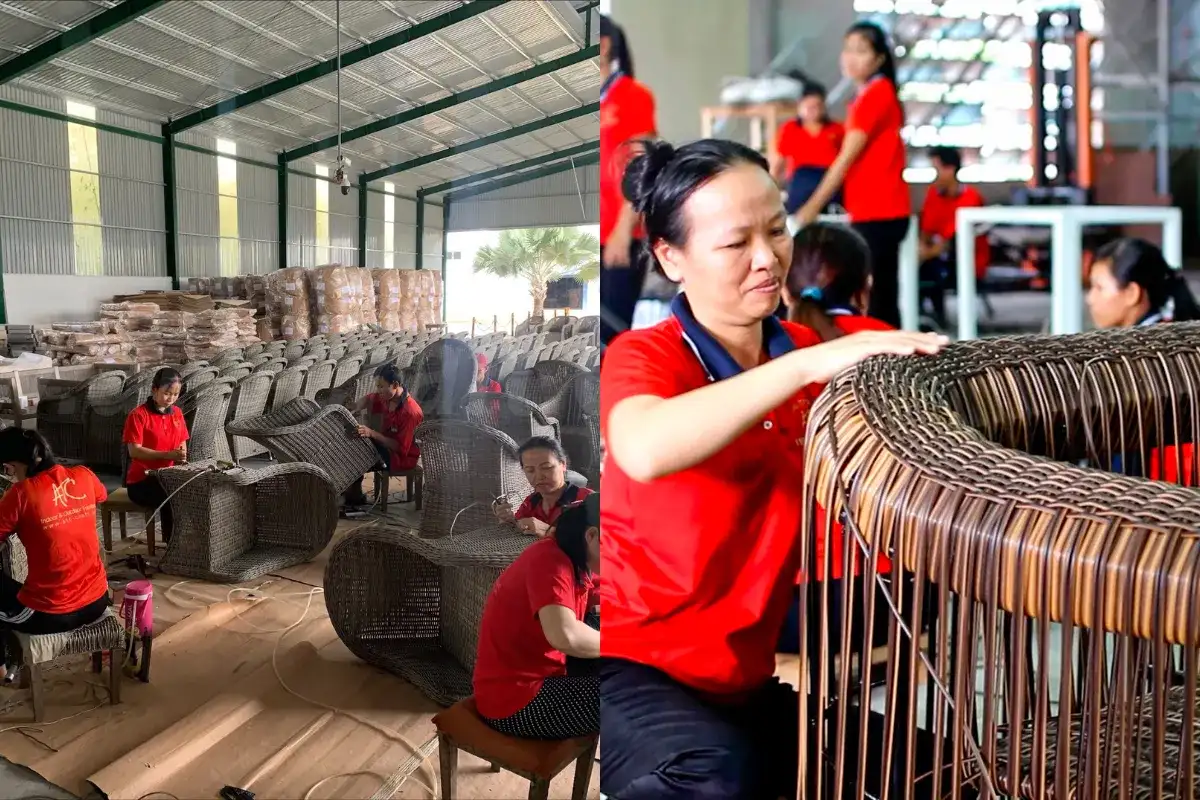
Consistent weaving quality ensures every outdoor furniture piece delivers lasting durability and a refined appearance.
Surface Finishing
- Examine powder-coated or painted surfaces for uniform color, complete coverage, and a smooth finish.
- Look for scratches, bubbles, pinholes, orange peel, or other visible finishing defects.
- Confirm that welded joints, edges, and concealed areas receive the same surface treatment as visible sections.
- Review the factory's inspection procedures to ensure surface finishing is checked before packaging.
Cushion Specifications
- Confirm that outdoor fabrics are resistant to UV exposure, moisture, mildew, and fading.
- Check foam density and resilience to ensure long-term comfort and shape retention.
- Inspect stitching, zippers, seams, and removable cushion covers for durability and ease of maintenance.
- Verify that fabric colors, textures, and specifications remain consistent across the production batch.

Well-made outdoor cushions combine durable fabrics, resilient foam, and removable covers for long-lasting comfort.
Outdoor Durability
- Request available test reports for UV resistance, corrosion resistance, and weather resistance.
- Confirm that screws, bolts, connectors, and other fastening hardware are suitable for prolonged outdoor exposure.
- Verify that finished products undergo final quality inspections before packing.
- Review the factory's procedures for identifying, segregating, and correcting defective products discovered during production or final inspection.
4. Sample Review and Pre-shipment Inspection
A factory audit provides confidence in a manufacturer's production system, but it should always be supported by product verification before shipment. Reviewing and approving a production sample allows buyers to confirm that the agreed specifications have been translated accurately into the finished product. Materials, dimensions, finishes, colors, construction details, and functional requirements should all be checked against approved drawings and technical specifications before mass production begins.
Once approved, the sample should serve as the reference standard throughout production. Any changes to materials, dimensions, finishes, or construction should be documented and approved before implementation to prevent inconsistencies between the approved sample and the final shipment.

Final quality inspections confirm materials, dimensions, packaging, and workmanship before products leave the factory.
Pre-shipment inspection serves a different purpose. Instead of evaluating a single approved sample, it verifies whether the completed order meets the agreed quality standards across the production batch. Buyers should inspect product appearance, dimensions, assembly quality, packaging, labeling, carton markings, and shipment quantities using recognized sampling methods, such as AQL (Acceptance Quality Limit), where appropriate. Conducting both sample reviews and pre-shipment inspections helps identify inconsistencies before products leave the factory, reducing the risk of quality claims, returns, or costly rework after delivery.
5. Red Flags Buyers Should Avoid
A factory audit is not only an opportunity to confirm a manufacturer's strengths but also to identify operational risks that could affect future production. While every factory has areas for improvement, recurring issues often indicate weaknesses in manufacturing processes or quality management that may lead to production delays, inconsistent product quality, and costly corrective actions.
One of the most important warning signs is the absence of standardized manufacturing procedures. If quality inspections are undocumented, work instructions differ between production lines, or employees provide inconsistent explanations of the same process, the factory may struggle to maintain consistent quality as production volumes increase. This often indicates that production relies more on individual experience than documented operating procedures.
Buyers should also evaluate material management and documentation. Poor storage conditions, incomplete batch traceability, inconsistent material identification, or missing testing and export documents can increase the risk of production inconsistencies and compliance issues. Throughout the audit, reliable manufacturers should be transparent about their production processes, inspection procedures, corrective actions, production capacity, and lead times. Factories that withhold information or make unrealistic commitments should be evaluated with additional caution before any purchasing decision.
6. How to Use the Checklist When Comparing Suppliers
After shortlisting factory direct outdoor furniture brands, use the same audit checklist to evaluate every supplier using consistent criteria. Applying a standardized checklist allows buyers to compare manufacturers based on measurable manufacturing capabilities instead of relying on pricing, presentation, or personal impressions during a factory visit.
Rather than focusing on a single category, buyers should evaluate the overall audit results across production capability, material management, product quality, export readiness, and quality management. A supplier that performs consistently across all categories is generally better positioned to support long-term business relationships than one that performs exceptionally well in only one area.
Many buyers also assign weighted scores to individual audit categories to make supplier comparisons more objective. For example, manufacturing capability and product quality may carry greater weight than export documentation if long-term production reliability is the primary purchasing priority. Using a structured scoring approach makes it easier to compare audit results across multiple factories and support more informed supplier selection decisions.
A factory audit should not be treated as a one-time activity. Periodic follow-up audits allow buyers to verify that manufacturing standards remain consistent as production volumes increase, new product lines are introduced, or quality requirements evolve. Regular evaluations also encourage continuous improvement while helping both buyers and manufacturers maintain clear performance expectations throughout their partnership.
7. Frequently Asked Questions (FAQs)
7.1 What is a furniture factory audit checklist?
A furniture factory audit checklist is a structured evaluation tool used to assess a manufacturer's manufacturing capability, quality management practices, material control, and export readiness before placing bulk orders. It enables buyers to compare potential suppliers using consistent, evidence-based criteria rather than relying solely on product samples or pricing.
7.2 Why is a factory audit important for high quality outdoor furniture?
Outdoor furniture is expected to withstand prolonged exposure to sunlight, moisture, and changing weather conditions. A factory audit helps verify whether the manufacturer has the production systems, inspection procedures, and quality controls required to produce high quality outdoor furniture consistently across multiple production batches.
7.3 Can a supplier pass a factory audit but fail a pre-shipment inspection?
Yes. A factory audit evaluates the manufacturer's management systems, production capability, and quality processes, while a pre-shipment inspection verifies the quality of a specific production batch. Changes in materials, workmanship, or process control after the audit can still result in quality issues that are identified during pre-shipment inspection.
7.4 What documents should buyers review during a factory audit?
Buyers should review business registration documents, export qualifications, quality procedures, production records, material certifications where applicable, and standard export documents such as commercial invoices, packing lists, and certificates of origin. Reviewing these documents helps confirm both manufacturing capability and export readiness.
7.5 Should buyers use a third-party inspection company for a factory audit?
For new suppliers or high-value orders, an independent third-party inspection company can provide an objective assessment of the factory's manufacturing capability, quality management system, and production processes. However, buyers with experienced sourcing or quality assurance teams may choose to conduct factory audits internally, depending on their purchasing requirements and available resources.